
This story is still moving. Browser makers are still asking eMudhra questions, and a few details are disputed. I've written this with what was known on 25 October 2026 and I'll update it if anything important changes.
The short version
First, what does eMudhra actually do?
When you open your bank's website, your browser shows a small padlock. Before it does that, it checks the website's ID card, which is called a certificate. A certificate is only accepted if a trusted company has stamped it. These companies are called Certificate Authorities, and you can think of them as the internet's passport office.
eMudhra is one of them. In India it is the biggest, and it also handles the digital signatures many of us use for income tax returns and company filings.
A detail that matters for this story: these companies don't use their main stamp every day. They lock it away and use helper stamps for routine work. Your browser trusts the helper stamp because the main stamp vouched for it. It was eight of these helper stamps that went wrong.
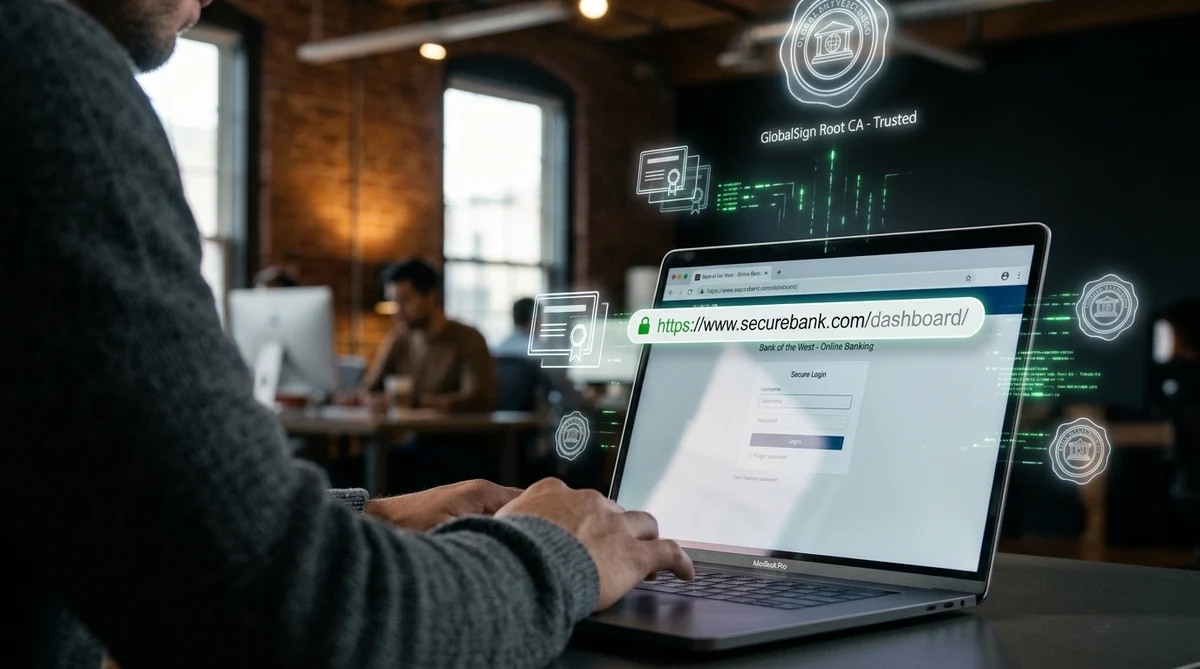
Figure 1: The Invisible Chain of Internet Trust. When you visit a secure portal, your browser silently verifies a cryptographic chain leading back to a trusted Certificate Authority (Root CA). If any intermediate helper stamp is compromised, the green padlock can vouch for a counterfeit destination without warning.
How your browser decides to trust a website
Anyone holding a helper stamp's secret key can stamp a fake ID card for any website
Where the number 4 comes in
Each stamp is protected by a secret key. The key is just a number, a bit like the combination of a lock. The difference is the size. A proper key for these stamps is a random number about 116 digits long.
There is also a public part, printed on every certificate. It is made from the secret key using maths that only works in one direction. Think of mixing two paints: easy to mix, impossible to separate again. So everyone can see the public part, and nobody can work backwards to the secret.
That only holds if the secret is too big to guess. eMudhra's weren't.
A proper secret key, and the one eMudhra used
On paper, both count as the same strong type of key
"Bits" is how security people measure guessing effort. Each extra bit doubles the work. The example key above was made for this post and isn't used anywhere.
The odd part is that from the outside, nothing looked wrong. I made a test certificate with the secret key set to 4 and opened it with the standard tool. It reported a full-strength 384-bit key, the same as a healthy one. The type of lock was right. The combination was terrible, and the certificate gives you no way to tell.
How did a tiny number end up there?
Creating new keys at a company like this is a formal event called a key ceremony. People meet in a secure room, follow a written script, and the keys are made inside a tamper-proof hardware box. Based on what eMudhra has told Mozilla, this is roughly how it went wrong:
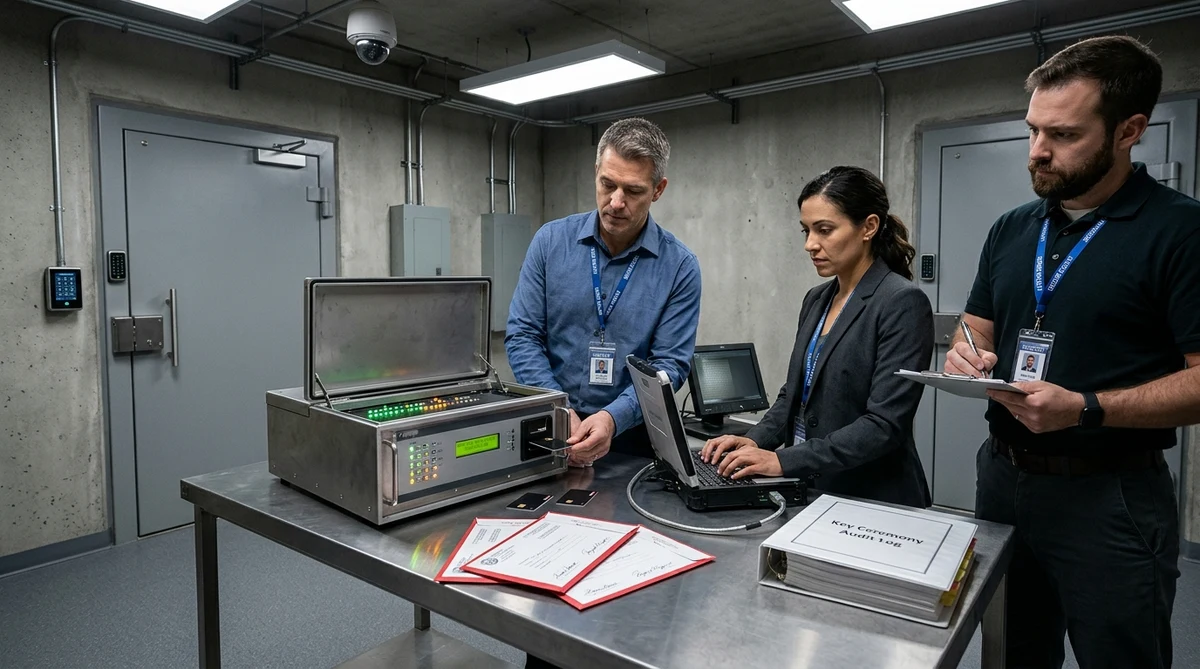
Figure 2: Inside a Cryptographic Key Ceremony. Generating institutional root and intermediate signing keys requires air-gapped vaults, dual-custody smart cards, and Hardware Security Modules (HSMs). The hardware flawlessly protected the generated keys—it simply protected an erroneous second set of single-digit test keys due to a procedure mix-up.
From the key ceremony to the discovery
Green went to plan, amber was risky, red is where it went wrong
What stays with me is that the expensive security box did its job. It kept the keys perfectly safe. It just kept the wrong keys safe. No hardware protects you from a mistake in the steps people follow.
How easy was it to guess?
Very. You don't need any hacking skill. You take the public part from the certificate, which anyone can download, and try the secret numbers one by one: is it 1? 2? 3? Each try takes a fraction of a millisecond.
Guessing the key by counting
Try each number until the result matches what's printed on the certificate
The biggest of the eight keys was 237, so 237 tries was the worst case.
Scott Helme, a well-known security researcher, was one of several people who tried it once the news broke. He wrote:
"One of eMudhra's certificate authority private keys is the number 4. Not a number that starts with 4… just, 4. […] I recovered all of them from their public certificates on my laptop just now, and it took less than a second."
Scott Helme, security researcherSo what could a criminal do with it?
The keys don't unlock anyone's data by themselves. What they let you do is pretend to be any website. A criminal could make a fake ID card for your bank, your email or a government portal, and your browser would accept it.
To use it, they would also need to sit between you and the internet, for example on a fake public Wi-Fi network or a hacked home router. Then it looks like this:
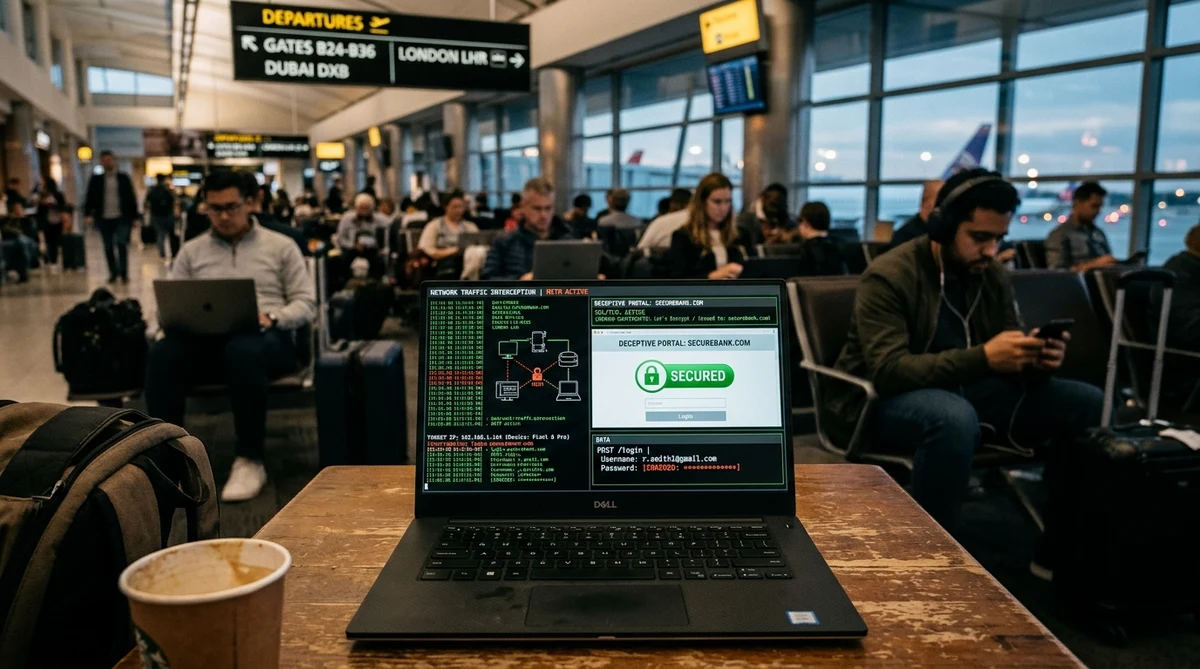
Figure 3: Man-in-the-Middle Interception at Transit Hubs. On untrusted public Wi-Fi (such as airports or cafes), an attacker possessing intermediate signing keys could silently forge an authentic-looking certificate for any domain. The victim's browser displays a reassuring padlock while credentials and session tokens are captured in transit.
A criminal in the middle, with a fake but "valid" ID card
You still see the padlock the whole time
Did anyone actually misuse it?
As far as anyone knows, no. CERT-In, India's cyber security agency, said on 21 October that it had seen no attacks. That fits with how fast the browsers moved, which I cover next.
People did show how easy it was, though. Within days of the news, more than 100,000 test certificates made with the leaked keys appeared in public logs, most of them pretending to be google.com. They were proofs that it worked, not attacks. Still, it tells you that once a key like this is known, anyone can use it.
What happened once it was found
One week in October 2026
The browsers moved quickly, which is reassuring. The part I'd underline is 20 October. Mozilla went further than blocking the eight bad stamps. It stopped trusting eMudhra's main stamp for this whole family of certificates. When the problem is how a company works, and not one unlucky leak, browser makers stop giving it the benefit of the doubt.
Am I affected?
Who needs to worry, and who doesn't
The risk is in anything that doesn't update itself
A lot of people in India asked me the same thing: is my tax filing or Aadhaar eSign safe? Yes. eMudhra runs two separate businesses on two separate trust systems, and only the website one broke.

Figure 4: Indian Sovereign Digital Signatures Remain Uncompromised. Everyday citizen compliance—including Income Tax Returns (ITR), MCA filings, and Aadhaar eSign—operates under India's Controller of Certifying Authorities (CCA) root hierarchy, entirely insulated from the affected global SSL/TLS website certificate pool.
Same company, two separate systems
The problem stayed on one side
That doesn't mean everyone is satisfied. The tech news site MediaNama argued that leaving the business isn't the same as being held accountable, and the Internet Freedom Foundation said it was writing to MeitY, the CCA and CERT-In. I think those are fair questions to ask of a company that also handles signatures for the country's tax filings.
This has happened before
In 2011 a Dutch company called DigiNotar, which did the same job, was hacked. The attackers made fake certificates for Google and used them to spy on people in Iran. Putting the two side by side is useful:
DigiNotar in 2011, eMudhra in 2026
| DigiNotar · 2011 | eMudhra · 2026 | |
|---|---|---|
| What went wrong | Hackers broke into its systems | Weak keys were made by mistake |
| Fake certificates | 531, including for Google | None by eMudhra; test ones by others after the news |
| People harmed | About 300,000 Gmail users in Iran were spied on | None confirmed so far |
| What happened next | Removed from all browsers and went bankrupt within weeks | Main stamp distrusted; left the website certificate business |
The common thread: a company like this sells trust. Once browsers withdraw it, that business is finished.
What you should do
For most people, this is short.
If you look after websites, servers or company IT
Your job is a bit longer. Browsers are protected, but plenty of business software keeps its own list of trusted stamps and only updates it when someone tells it to.
What IT teams should do, in order
Start at the top
Commands: check a website's certificate chain
This lists every certificate a site sends and flags the affected eMudhra ones. Replace example.com with your domain.
# save every certificate the server sends
openssl s_client -connect example.com:443 -servername example.com -showcerts </dev/null 2>/dev/null \
  | awk '/BEGIN CERT/,/END CERT/' > chain.pem

# show who issued each one, and flag the affected eMudhra stamps
openssl crl2pkcs7 -nocrl -certfile chain.pem | openssl pkcs7 -print_certs -noout \
  | grep -E "EM (DV|OV|EV) TLS CA - G3[BC]|emSign ECC Root CA - G3" \
  && echo "AFFECTED CHAIN" || echo "no affected eMudhra certificate in this chain"
Commands: update trusted-certificate lists
# Debian / Ubuntu
sudo apt update && sudo apt install --only-upgrade ca-certificates
# RHEL / Alma / Rocky
sudo dnf update ca-certificates
# Python apps
pip install --upgrade certifi

# is the distrusted eMudhra root still in the Linux list?
awk -v cmd='openssl x509 -noout -subject' '/BEGIN/{close(cmd)};{print | cmd}' \
  /etc/ssl/certs/ca-certificates.crt | grep -i "emSign ECC Root CA - G3"

# Java
keytool -list -v -cacerts -storepass changeit | grep -i "emSign ECC Root CA - G3"
If it still shows up, your vendor may not have shipped the update yet, so check their advisory. eMudhra's older emSign Root CA - G1 is not being removed, so search for the exact name above and not just "emsign".
Script: test whether one of your own keys is tiny
For teams that create their own keys. It tries every secret key from 1 to 4,095 against a certificate. On my test certificate with key 4 it answered in about a tenth of a second. Passing this doesn't prove a key is good. Failing it proves the key is broken.
# usage: python weak_key_check.py cert.pem
import sys
from cryptography import x509
from cryptography.hazmat.primitives.asymmetric import ec

cert = x509.load_pem_x509_certificate(open(sys.argv[1], "rb").read())
pub = cert.public_key()
if not isinstance(pub, ec.EllipticCurvePublicKey):
    sys.exit("Not an EC key, nothing to check")

target = pub.public_numbers()
for d in range(1, 1 << 12):          # every private key from 1 to 4,095
    if ec.derive_private_key(d, pub.curve).public_key().public_numbers() == target:
        print(f"WEAK: private key is {d}")
        break
else:
    print("No tiny private key found")
Your quick checklist
Update your phone, computer and browser
And the devices of parents or kids you help with tech.
Use mobile data for banking outside home
Not café, hotel or airport Wi-Fi.
Never click past a certificate warning
If your browser says a connection isn't private, close the tab.
IT teams: update trusted-certificate lists everywhere
Servers, containers, Java and Python apps, then restart.
Website owners: replace any eMudhra certificate
Before browsers stop accepting it.
What I take away from this
Nothing was stolen here, and I keep coming back to that. All the expensive hardware and audits were in place, and a naming mix-up during one meeting still got through. Security comes down to the boring steps, like checking that the key you're about to use is the one you meant to make.
The clue in June 2025 bothers me too. Something didn't match, it got patched over, and the real problem sat there for another 16 months. If a "small" error doesn't make sense, it's worth stopping to find out why.
And for the rest of us, the advice is boring but it works. Keep your devices updated, because that's how the fix reached millions of people within days.
Sources
- Mozilla Bugzilla 2083449: eMudhra private key compromise of intermediate certificates
- Mozilla Bugzilla 1970728: the June 2025 CRL signing incident
- Kudelski Security: eMudhra intermediate CA private key compromise
- Cloudflare: 8 eMudhra certificates are compromised, here's what you need to know
- Scott Helme: Eight bits of trust, eMudhra's CA keys cracked in milliseconds
- Google: Protecting Chrome and Android users from compromised eMudhra intermediates
- eMudhra press release: exit from the global SSL/TLS certificate business
- Help Net Security: eMudhra blunder left trusted CA signing keys exposed
- The Register: eMudhra's private keys compromised, one was the number 4
- The Hacker News: Eight eMudhra CA keys compromised
- BleepingComputer: Mozilla, Google, Apple block compromised eMudhra CA certificates
- CyberScoop: eMudhra shuts down its certificate business
- Business Today: MeitY says Indian DSC and eSign unaffected
- ThePrint: MeitY sets up team to probe eMudhra certificate breach
- PSU Watch: CERT-In warns of fake websites and cyber fraud
- MediaNama: Why eMudhra's exit is not enough
- Wikipedia: DigiNotar