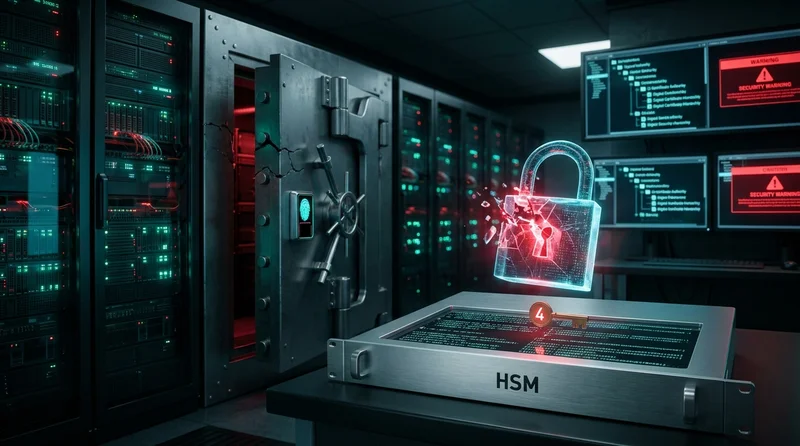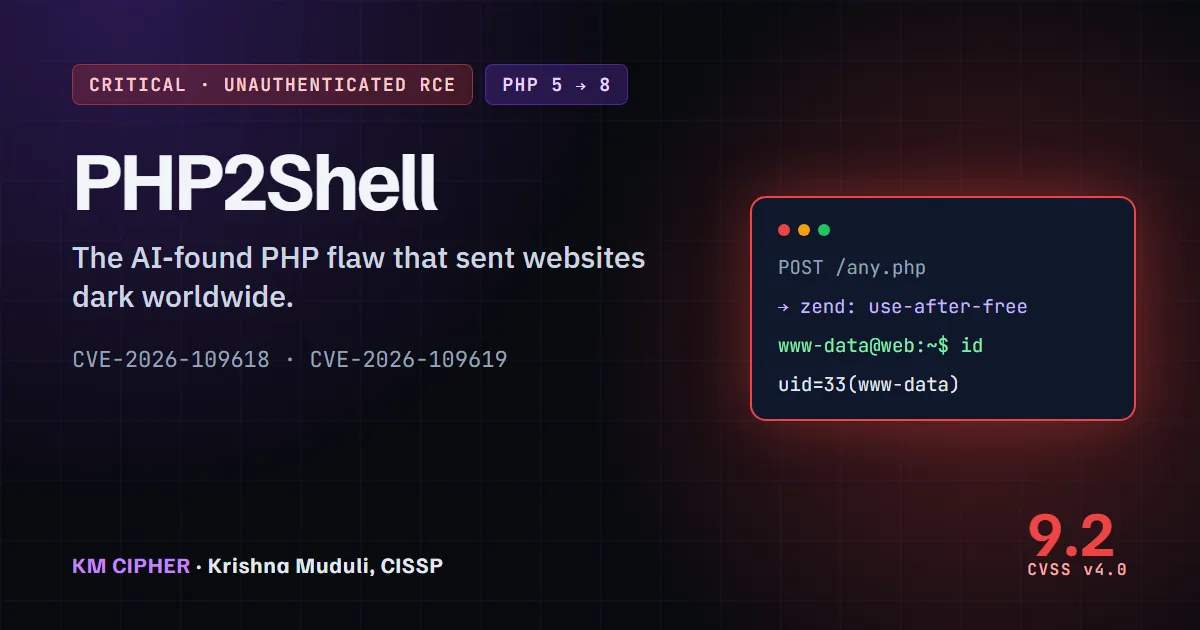

This story is still moving. Binance's report of 3 November is a preliminary one, and the investigation is ongoing. I've written this with what was known on 8 November 2026 and I'll update it if anything important changes.
The short version
First, where does an exchange keep your coins?
When you buy crypto on an exchange like Binance, the exchange holds the coins for you, much like a bank holds your cash. Most of it sits in cold wallets, which are kept offline and are slow to move on purpose. A smaller amount sits in hot wallets, which stay online so that withdrawals can go out quickly.
Every withdrawal from a hot wallet needs a digital signature. Exchanges don't let a person type that signature in. A locked-down internal system, which I'll call the signing service, checks each withdrawal request and signs it if it looks right. In this attack, the criminals never stole the secret keys. They got the signing service to sign for them.
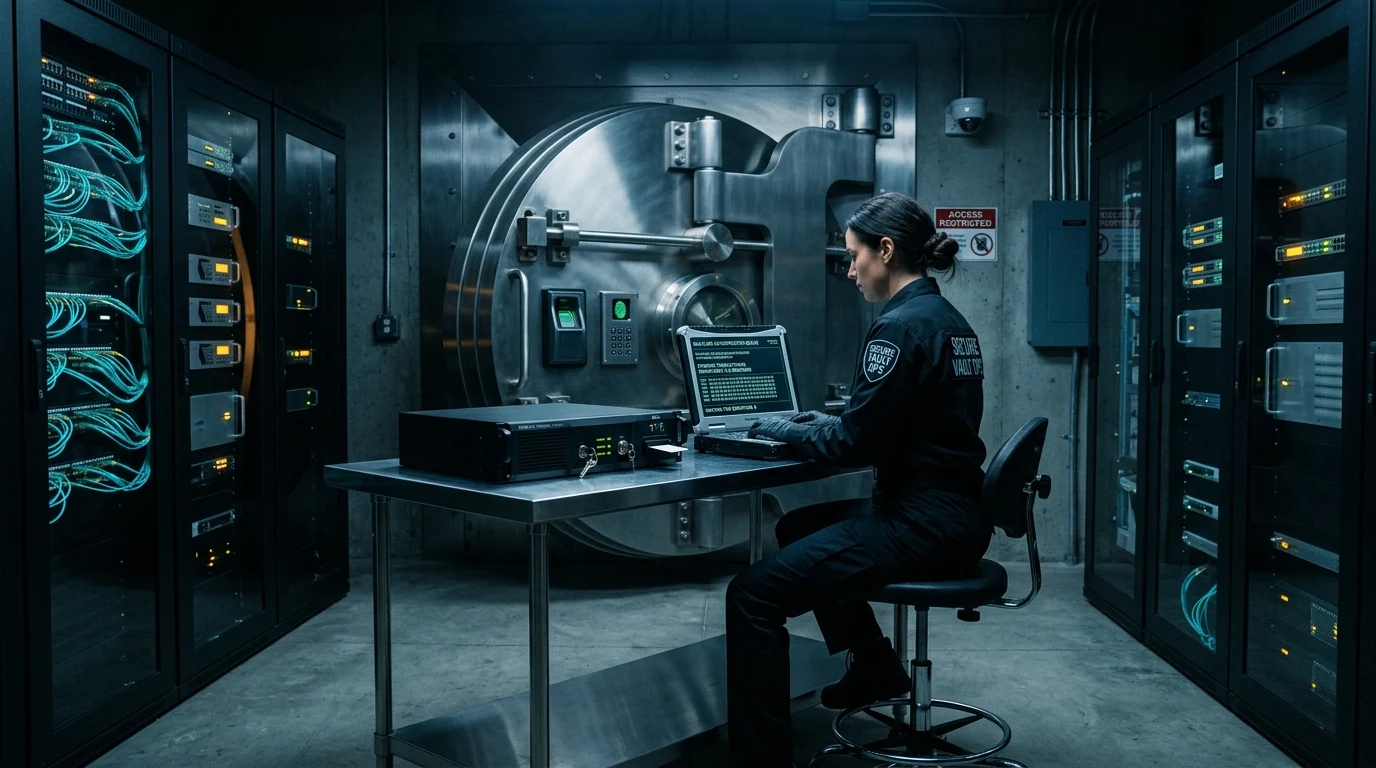
Figure 1: Anatomy of institutional crypto custody. Cold storage wallets rely on air-gapped Hardware Security Modules (HSMs) and biometric multi-custody safeguards deep inside subterranean vaults. Hot wallets operate online to process routine customer withdrawals, relying on an automated signing service to verify requests. In this attack, the adversaries never cracked the HSMs or leaked the root keys—they compromised internal credentials to instruct the signing service itself.
Where An Exchange Keeps Your Coins
Binance holds over 95% of customer assets in offline vaults. The attackers never touched the private keys—they commandeered the automated signing engine that authorizes movements.
Subterranean, physical HSM clusters disconnected from the internet. Requires multi-custody hardware key ceremonies and 24-48h manual timelocks.
Connected directly to 10+ public blockchains (BTC, ETH, BNB, SOL) to fulfill routine customer withdrawal requests in seconds.
Automated internal microservice that evaluates withdrawal limits and signs blockchain transactions when instructed by authorized DevOps containers.
It started with a job offer
In September, a software engineer at Binance got a message on a well-known job-hunting site. The sender said they were a Project Director at a company that, it turned out, doesn't exist. The engineer's profile mentioned his work at Binance, and that was the point. The attackers weren't looking for any developer. They wanted someone inside Binance.
What followed looked like a normal hiring process. There was a first round with an "HR" person, then a second round with someone claiming to be the company's CEO, on live video. Then came the usual next step: a take-home assessment. He was asked to download a code project and run it on the computer he had in front of him, which was his Binance laptop.

Figure 2: The deceptive interview lure. Over the shoulder of the candidate: a live, professional video call with persuasive recruiters alongside a technical assessment project in VS Code. Running ./run_tests.sh seemed routine, but the package payload silently swapped local developer binaries to establish a covert command channel into the corporate network.
Anatomy of the Fake Interview Exploit
How North Korea's TraderTraitor bypassed corporate endpoint detection by weaponizing the tech hiring process.
Adversaries create a fictitious tech firm and approach Binance engineers on LinkedIn with personalized pitches for executive compensation and remote flexibility.
Two professional video interview rounds with live cameras ("HR Recruiter" and "CEO") establish human rapport, completely disarming security suspicion over weeks.
Candidate downloads a technical assessment project onto their work laptop. Running ./run_tests.sh triggers hidden scripts that swap the macOS pyenv binary.
Antivirus and EDR detect zero anomalous signatures. A persistent reverse shell opens to North Korea, allowing attackers to harvest container deploy tokens.
Hidden inside the project was malware. Once it ran, it quietly swapped a common developer tool on the Mac (pyenv, which manages Python versions) for a booby-trapped copy and opened a command line for the attackers. Binance says its security software did not catch it.
"It was not a single isolated breach or a simple phishing incident. The attackers combined a range of techniques, including social engineering by fake recruitment interviews, malicious software downloads, compromised internal AI tooling, endpoint compromise, and an advanced transaction-authorisation method."
Binance incident report, 3 November 2026This wasn't their first try
The part that stays with me is June. Months before the interview, an engineer on Binance's Wallet DevOps team went looking for a popular AI coding tool and installed a tampered copy of Homebrew, the app installer many Mac developers use. Binance's security team caught it, replaced his laptop and reset his passwords. But by then the attackers had learned his job and the names of his colleagues on the wallet team. They came back three months later through a different door.
From one laptop to the vault
One infected laptop isn't the same as $6 billion. Here is how the attackers got from one to the other, based on what Binance has published so far:
Five Months: From Reconnaissance to The Vault
North Korea demonstrated extraordinary persistence. When an initial lure was caught in June, they used the reconnaissance to mount the fatal September breach.
./run_tests.sh on their Binance computer. The hidden payload stealthily swaps pyenv with a trojanized version, opening a command-line backdoor that eludes corporate EDR.Notice how little of this is "hacking" in the movie sense. Every step after the coding test used something that already existed: a colleague's laptop, an internal tool, a token left on a computer, a service that signs what it's asked to sign. The attackers just had to be patient and use what they found.
The trick that kept the money flowing
Binance noticed and paused withdrawals, but money kept leaving for a while afterwards. That's because of a feature on Ethereum called EIP-7702.
The simplest way I can put it: EIP-7702 lets a wallet give a piece of software a kind of power of attorney. The wallet keeps its secret key, but the software is allowed to act on its behalf. It's useful for legitimate things, like paying fees or bundling payments. The attackers used Binance's own signing service to grant that power of attorney over a Binance hot wallet to a program they controlled.
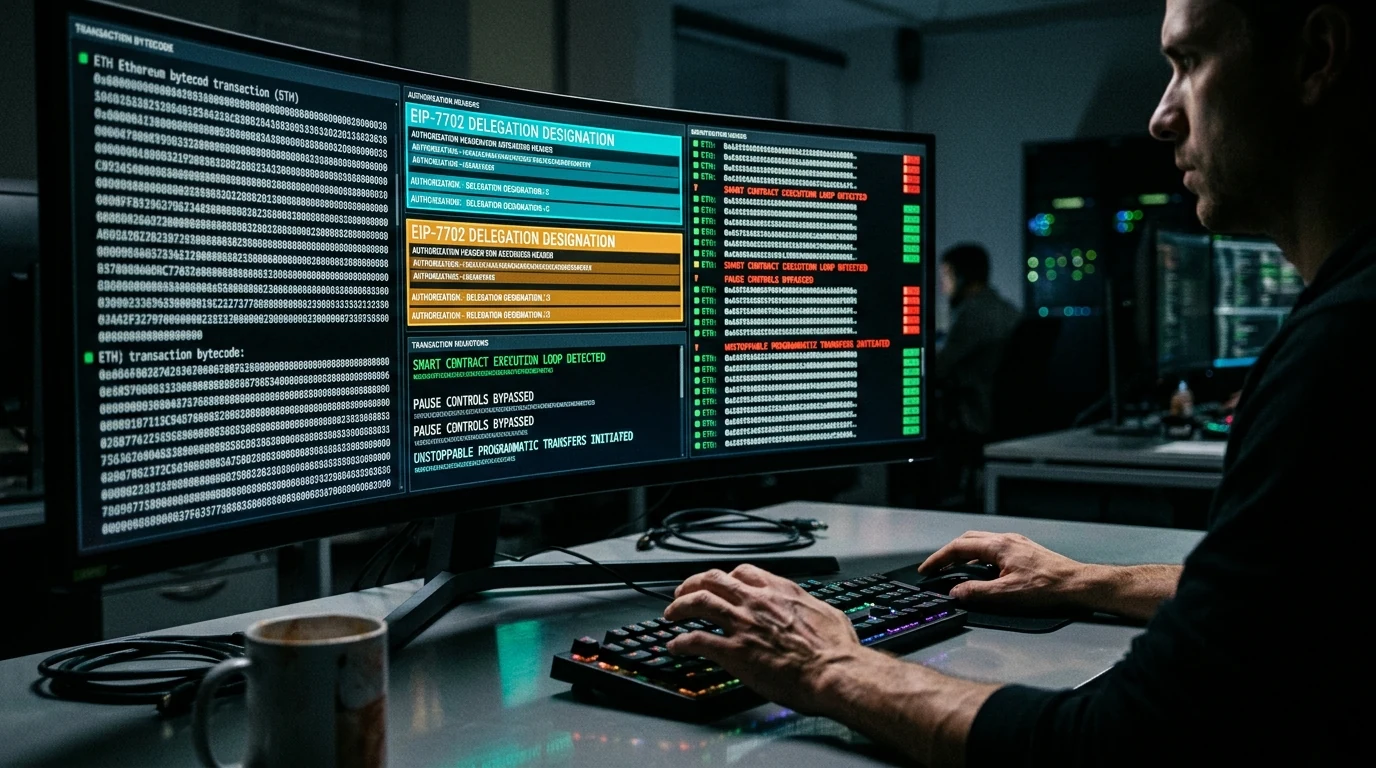
Figure 3: Programmatic drain via EIP-7702 delegation. The terminal reveals the automated delegation in action. Once the compromised signing service vouched for the attacker's smart contract designation, programmatic transfers continued to broadcast directly across block confirmations, bypassing manual pause switches until the delegation itself was revoked on-chain.
EIP-7702: The Smart Contract "Power of Attorney"
Why flipping the emergency withdrawal pause switch did not immediately halt the on-chain drain.
Under adversary control, the signing KMS signed an on-chain EIP-7702 delegation authorization payload for the Binance hot wallet address.
The hot wallet retained its private key, but Ethereum designated the attacker's smart contract as its authorized proxy to move funds.
The smart contract executed automated sweeps directly across Ethereum mainnet blocks, completely independent of Binance's internal servers.
Blockchain analysts at TRM Labs noticed something else that points the same way. Binance wallets on different blockchains, which use different kinds of keys, all produced valid signatures for the attackers within about half an hour. You don't get that by stealing one key. You get it by controlling the system that signs for all of them.
Where did the money go?

Figure 4: Incident response war room & multi-chain asset tracing. Forensic teams and blockchain intelligence analysts (TRM Labs, Chainalysis) map the sprawling multi-chain dispersal in real time. Over $2.85 billion in centralized stablecoins were frozen across issuers, while roughly $3.5 billion in native Bitcoin and Ether surged toward decentralized bridges and mixing protocols.
Where The $6.34 Billion Went
Centralized stablecoin blacklists enabled immediate billions in freezes, while permissionless Layer-1 assets surged into mixing protocols.
Tether, Circle, Paxos, Ripple, and Arbitrum's Security Council executed centralized smart contract blacklists within 24 hours, freezing the stolen tokens on-chain.
Over 420,000 ETH and 18,270 BTC have no central administrator. Attackers split and laundered these funds across cross-chain bridges and Tornado.cash mixers.
Binance deployed its corporate reserves and Secure Asset Fund for Users (SAFU) to guarantee all customer deposits. Customer accounts remained 100% solvent.
Here the type of coin made a big difference. Stablecoins such as USDT and USDC are issued by companies (Tether and Circle), and those companies can freeze their own tokens. Within the first day, Tether, Circle, Ripple, World Liberty Financial and Arbitrum's Security Council had frozen about $2.7 billion. By 3 November, Binance put the total frozen or intercepted at about $2.85 billion.
Bitcoin and ether have no company in charge, so nobody can freeze them. TRM Labs reported that the attackers were still holding more than 420,000 ETH and 18,270 BTC, worth about $2.4 billion at the time. North Korean groups have laundered stolen crypto through mixers and cross-chain swaps before, and investigators expect the same this time.
What happened next
One Week: From Theft to Public Disclosure
How Binance, blockchain forensic investigators, law enforcement, and token issuers coordinated over 7 high-stakes days.
OCT
OCT
OCT
NOV
NOV
Binance's co-founder Changpeng Zhao didn't soften it. He said a hack of this size "means serious security failures occurred", and described it as what "appears to have been a prolonged multi month/year attack targeting hundreds of employees and systems, with a few ultimately compromised." Binance itself said it had detected and stopped 57 North Korea-linked attempts in 2026. It only had to miss one.
Am I affected?
Who Needs to Worry, and About What?
The theft hit Binance's internal infrastructure and liquidity pools—not customer logins. Here is how the risk breaks down.
Binance's SAFU fund and reserves fully absorbed all losses. Your account credentials, 2FA, and personal funds were not compromised.
Opportunistic scammers are circulating fake "refund" and "$150 hack compensation" portals via SMS and Twitter. Clicking them exposes your wallet or login.
North Korean threat actors are actively reaching out to developers on LinkedIn with fake recruitment offers and booby-trapped coding assessments.
Any institution where an engineer's laptop holds persistent deployment tokens that can command a signing service shares the exact vulnerability Binance suffered.
This has happened before
The fake job interview is not new. North Korean groups have used it for years, in campaigns researchers call Operation Dream Job and Contagious Interview. What's new is the size of the result. Put the big ones side by side:
North Korea's Recruitment Heist Playbook
The common thread across history's largest crypto thefts: attackers never break the cryptographic vault—they manipulate the humans who hold the keys.
Vector: Fake recruiter, 2 live video screens, Trojan coding test swapping pyenv, EIP-7702 smart contract delegation.
Vector: Compromised laptop of a Safe{Wallet} infrastructure developer; lateral pivot into multisig deployment tokens.
Vector: Fake LinkedIn recruiter targeting Ginco (wallet vendor) engineer with a booby-trapped Python assessment test.
Vector: Fake LinkedIn recruiter contacting Sky Mavis senior engineer with a Trojanized PDF "offer letter" payload.
What you should do
If you're looking for a job
This is the part I'd most like people to read, because it's where the attack started.
And it's fine to say no. A real employer will understand if you say "I don't run unknown code on my machine, can we do this as a screen-share or in an online editor instead?" A fake one will push.
If you use Binance or any other exchange
If you run security for a company that holds money
The lesson here isn't "train people better". Training helps, but Binance was clearly trying and still got caught. The real lesson is to make sure that one person's laptop can't reach the crown jewels.
What Security Teams Must Do (In Priority Order)
Human training is never enough. Security architecture must be resilient to individual endpoint compromise.
Homebrew, pyenv, npm).Commands: look at a coding test before you run it
A quick first look. This won't catch everything, but it catches the lazy cases and gives you a reason to ask questions. Run it from inside the project folder.
# what runs automatically when you install or test? (Node projects)
grep -A15 '"scripts"' package.json

# anything that downloads, decodes or executes hidden code?
grep -rnE "curl |wget |eval\(|exec\(|base64|child_process|subprocess|os\.system" \
  --include=*.js --include=*.ts --include=*.py --include=*.sh --include=*.json . | head -50

# anything that touches your shell setup or developer tools?
grep -rnE "\.zshrc|\.bashrc|brew --prefix|pyenv|/usr/local/bin|/opt/homebrew" . | head -50
Commands: run a coding test in a throwaway container
This gives the project a copy of itself and nothing else: no network, no access to your home folder, your keys or your company's tools. When you close it, it's gone. Use a matching image (for example python:3.12) for other languages.
# copy the project in read-only, with no network and no access to anything else
docker run --rm -it --network none \
  -v "$PWD":/task:ro -w /work node:22 \
  bash -c "cp -r /task/. /work && bash"

# if the test truly needs packages, install them in a separate step you can watch,
# then cut the network again before running the code
Do this on a personal machine, never a work one. A container lowers the risk; it doesn't remove it.
Commands: check your Mac's pyenv and Homebrew (the tools abused here)
This shows where pyenv really points and when it last changed. If it changed on a day you didn't update anything, or it isn't the Homebrew-managed file, stop and talk to your security team before you "fix" it. Reinstalling destroys evidence.
# every pyenv on your PATH, in the order your shell finds them
which -a pyenv

# where the Homebrew copy really lives, and when it last changed
ls -la "$(brew --prefix)/bin/pyenv"
stat -f "%Sm  %N" "$(readlink -f "$(brew --prefix)/bin/pyenv")"

# the version Homebrew thinks you have, and Homebrew's own health check
brew list --versions pyenv
brew doctor
Your quick checklist
Never run interview code on a work computer
Use a personal machine and a throwaway sandbox.
Check that the recruiter and company are real
Look them up outside the job site before the first call.
Ignore "compensation" messages about the hack
Only trust the official app or website, typed in yourself.
Turn on a passkey and a withdrawal allow-list
On every exchange account you have.
Security teams: remove standing tokens from laptops
Nothing on one computer should be enough to move money.
What I take away from this
Binance stopped 57 North Korea-linked attempts this year and still lost $6 billion to the 58th. That's the hard truth about attacks on people: the defender has to be right every time, and the attacker only once. So the goal can't just be "nobody falls for it". It has to be "when somebody falls for it, it doesn't matter much".
The June incident bothers me most, as the June clue did in my eMudhra write-up. Something was caught and cleaned up, and it looked finished. It wasn't. The attackers had learned who to go after, and they came back. When you close an incident, it's worth asking what the attacker learned, not only what they touched.
And for the rest of us, the advice is simple. Your job search is now part of your attack surface. Be friendly with recruiters, be curious about offers, and never run their code on the computer your employer trusts.
Sources
- Binance: incident report on the 29 October security incident (3 November 2026)
- Binance: security update of 30 October 2026
- FBI: North Korea responsible for $6 billion Binance attack
- TRM Labs: North Korea steals $6.36 billion from Binance in the largest hack in history
- Help Net Security: Fake job interview opened the door to $6.34 billion Binance heist
- Help Net Security: Binance hit by $6.3 billion theft
- Help Net Security: FBI pins Binance heist on North Korea while scammers circle anxious users
- BleepingComputer: Binance says fake job interview led to $6.3 billion crypto heist
- BleepingComputer: FBI links $6.3 billion Binance crypto heist to North Korean hackers
- Fortune: North Korea used LinkedIn, fake job interviews to trick Binance engineer
- NBC News (Reuters): Hackers used fake job interview before $6.3 billion hack
- Axios: Binance's $6.3 billion hack began with a fake job
- Engadget: Axie Infinity (Ronin) hack tied to fake LinkedIn job offer
- SecurityWeek: FBI blames North Korea for $308M DMM Bitcoin hack
- CSIS: The Bybit heist and the future of US crypto regulation