
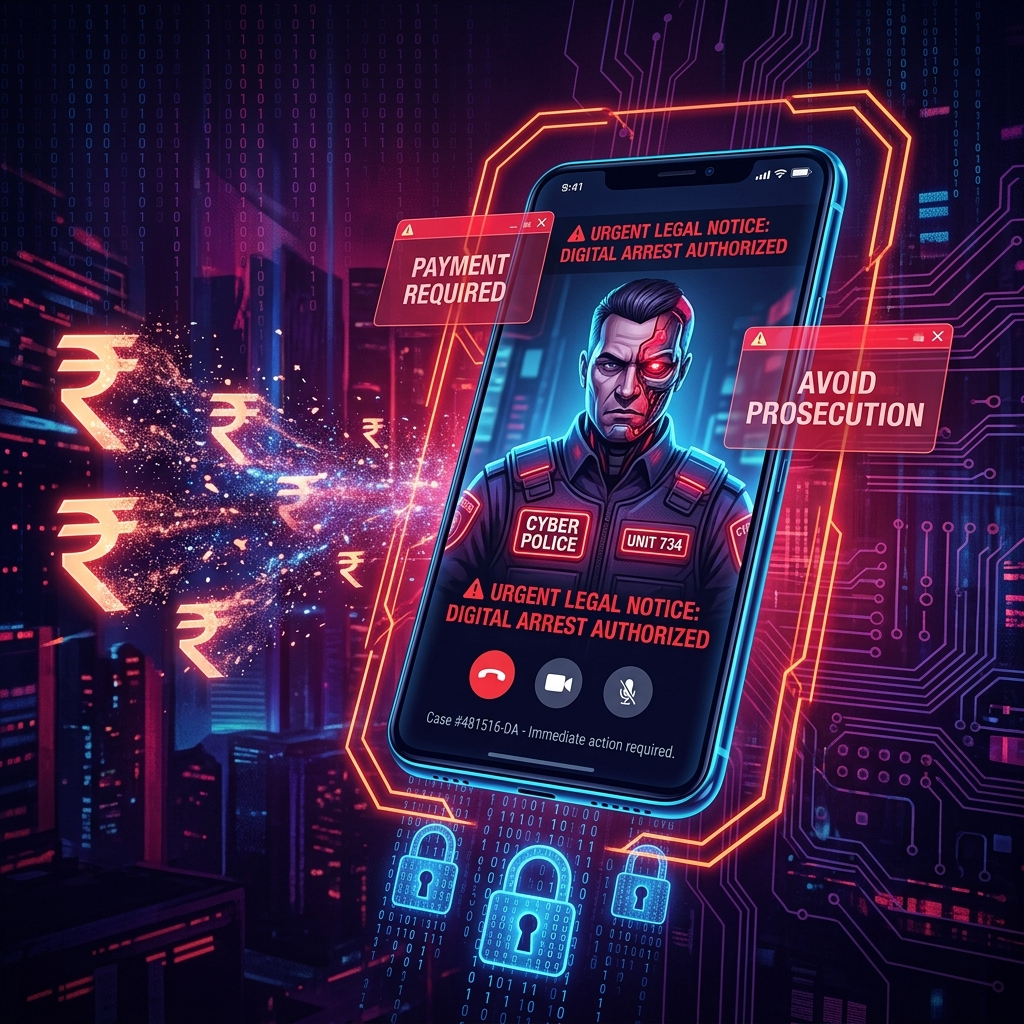
The Call That Changed Everything
Meera Sharma was 57 years old when the phone rang on a Tuesday morning in June 2025. She was a college lecturer in Bengaluru, standing in her kitchen, coffee still warm in her hand. The caller sounded professional. Serious. Official.
Meera's heart stopped.
She had never done anything wrong in her life. Her salary went straight to her bank. She paid bills on time. Her biggest worry was her daughter's wedding next year. But in that moment, as the caller rattled off her real name, her real address, her real Aadhaar number — she believed him.
What happened next would take six months of her life and steal ₹2.05 crore of her family's savings.
This is not a movie. This is happening to Indians like you and me, right now, in 2026.
How It Starts: The Perfect Psychological Trap
The "digital arrest" scam works because it exploits something deeper than greed. It exploits fear.
Here's exactly how it happens:
The Initial Call
You receive a call from an unknown number. The caller identifies himself as a police officer, CBI agent, ED official, or RBI representative. He knows your name. Your Aadhaar number. Sometimes your address. Your email. Your recent transactions.
How does he know all this? From public data breaches. From leaked government databases. From your social media. The knowledge itself becomes proof of authority in your panicked mind.
He pauses. Lets the panic set in.
And here's the genius of it: there is no such thing as digital arrest in Indian law. No law allows anyone to arrest you via video call. But you don't know that. Most people in India don't know that.
The "Evidence"
The caller transfers you to a "police officer" on Skype or WhatsApp. This person is wearing a uniform. Behind him is what looks like a police station — shelves with files, a door with "Mumbai Police" written on it, the Ashoka emblem on the wall.
Everything looks real. Some of it is AI-generated. Some of it is a painted backdrop filmed on a phone. But in the moment — when you're terrified — it all looks real.
The "officer" shows you forged documents. Your name on an FIR. Your Aadhaar linked to "terror funding." Names of shell companies that supposedly used your identity. Everything is printed on official-looking letterhead. Everything has official-looking registration numbers.
The Isolation
This is the scariest part. The officer tells you:
You are now completely alone with your terror.
For six months, Meera was on video calls with these scammers almost every day. Six months. Imagine being under "investigation" for 180 days straight. Imagine not being able to tell your husband. Imagine lying awake at 3 AM, thinking about jail.
"He was talking so nicely — that's why I thought everything would be okay."
— Meera Sharma, recounting the call to a cyber crime officerThe psychological torture is deliberate. It's the hook that keeps you compliant.
The Bleeding Begins: How They Extract Money
Once they have you isolated and terrified, the money requests begin.
"We need to verify your savings"
The officer tells you that to "clear your name," you need to transfer your savings into a government-verified account. "The ED will hold it temporarily to prove it wasn't used in the crime. Once the investigation closes, you'll get every rupee back."
Meera transferred her first ₹20 lakh.
"More verification is needed"
Then it's more money. ₹50 lakh. ₹1 crore. "The investigation expanded. We need more proof."
Meera sold her first plot of land. ₹60 lakh from the sale went into scammer accounts.
"Family member's account is also flagged"
"We found your husband's name in the same case. To protect your family, he also needs to transfer his savings."
Meera convinced her husband. They sold their second plot.
"You need to buy government bonds"
Some scammers evolve beyond simple transfers. They ask you to buy "government securities" or invest in "verified schemes" to prove the money is legitimate. The investment goes into a fake portal that shows your balance growing. It's all theater. You now own nothing.
In six months, Meera transferred ₹2.05 crore across multiple bank accounts, multiple shell companies, multiple wire transfers. The pattern was always the same:
Transfer → Relief (the scammer praises you) → New problem → More fear → More money
On December 20, 2025, Meera finally broke.
She confided in her sister. Her sister immediately told her: "This is a scam. There is no digital arrest."
Meera's world fell apart twice — once when she thought she was a criminal, and once when she realized she had been fooled.
The Scope: You Are Not Alone
The Supreme Court of India initiated suo motu proceedings on this case. The CBI has re-registered cases involving losses exceeding ₹10 crore each. The RBI increased compensation limits to ₹30 lakh from July 2026.
Here's what India lost to digital arrest scams in the last 18 months:
In January–April 2026 alone, WhatsApp shut down 9,400 accounts being used for digital arrest scams across India. The Enforcement Directorate is investigating money laundering involving 200+ shell companies. The perpetrators are mostly operating from Cambodia, Myanmar, and Laos — organized crime centers where human trafficking victims are forced to run these scams.

Recent Cases From 2025–2026:
| Victim Profile & City | Scam Story Used | Duration | Loss / Recovery |
|---|---|---|---|
| 92-year-old Resident Delhi |
Fake Aadhaar money-laundering video call | Several Days | ₹2 Crore Recovered Family alerted police in 48h |
| Retired Software Engineer Faridabad |
Held under fake digital "house arrest" threat | 14 Days | ₹2.81 Crore Lost Accounts drained completely |
| IISc Professor Bengaluru |
Export control law violation threat | Immediate | ₹83 Lakh Lost |
| Tech CEO Bengaluru |
Fake ED money laundering verification | 28 Hours | ₹3.7 Crore Lost Dealing with severe PTSD |
These are not poor people who didn't know better. These are educated, vigilant, intelligent people. Professors. Engineers. Doctors. Businesspeople.
Digital arrest scammers don't target the gullible. They target the smart people, because the smart people trust their own judgment. And when authority speaks to them in a language they understand — with real data they know is real — they believe it.
The Psychology: Why Smart People Fall For It
Let me explain the 6 psychological triggers that make digital arrest so devastatingly effective:
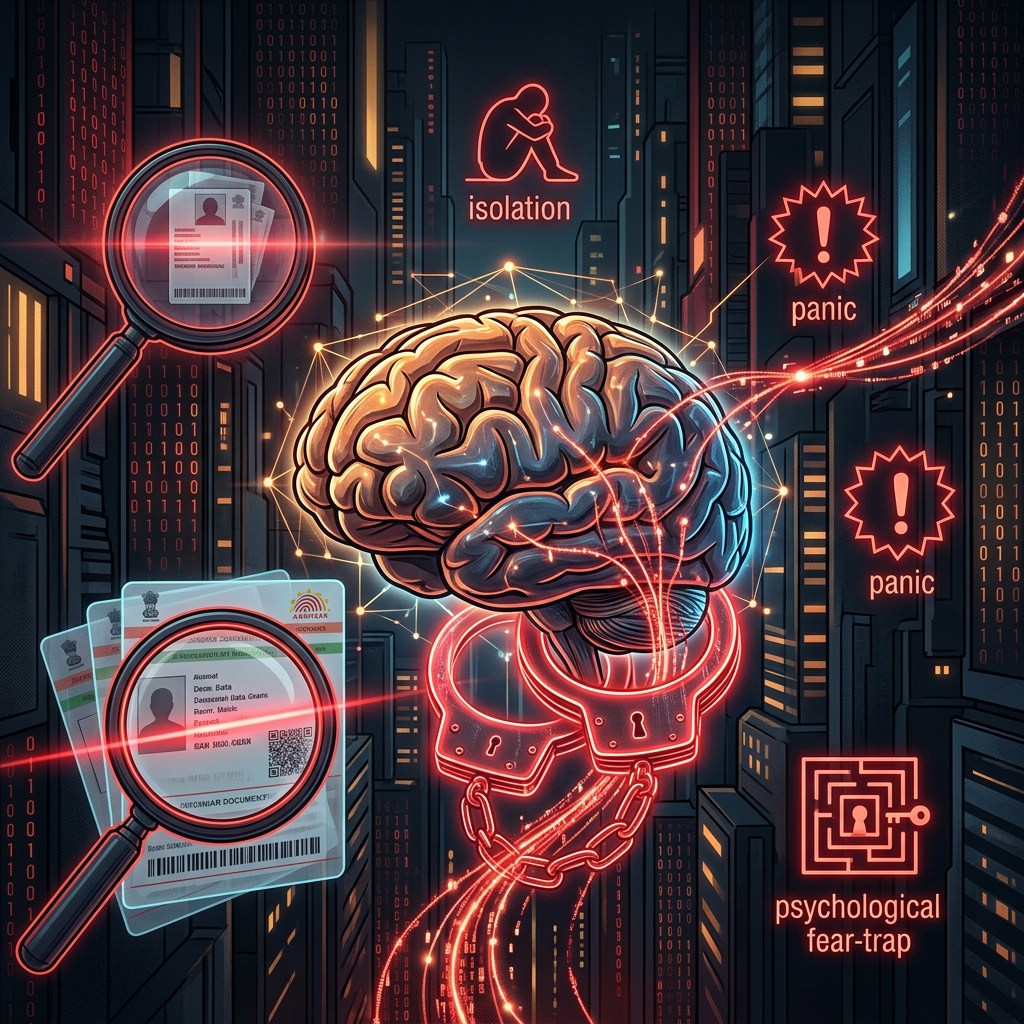
These six forces work together to disable your judgment. Even an IIT-educated CEO can fall for it.
How To Protect Yourself: 7 Critical Rules
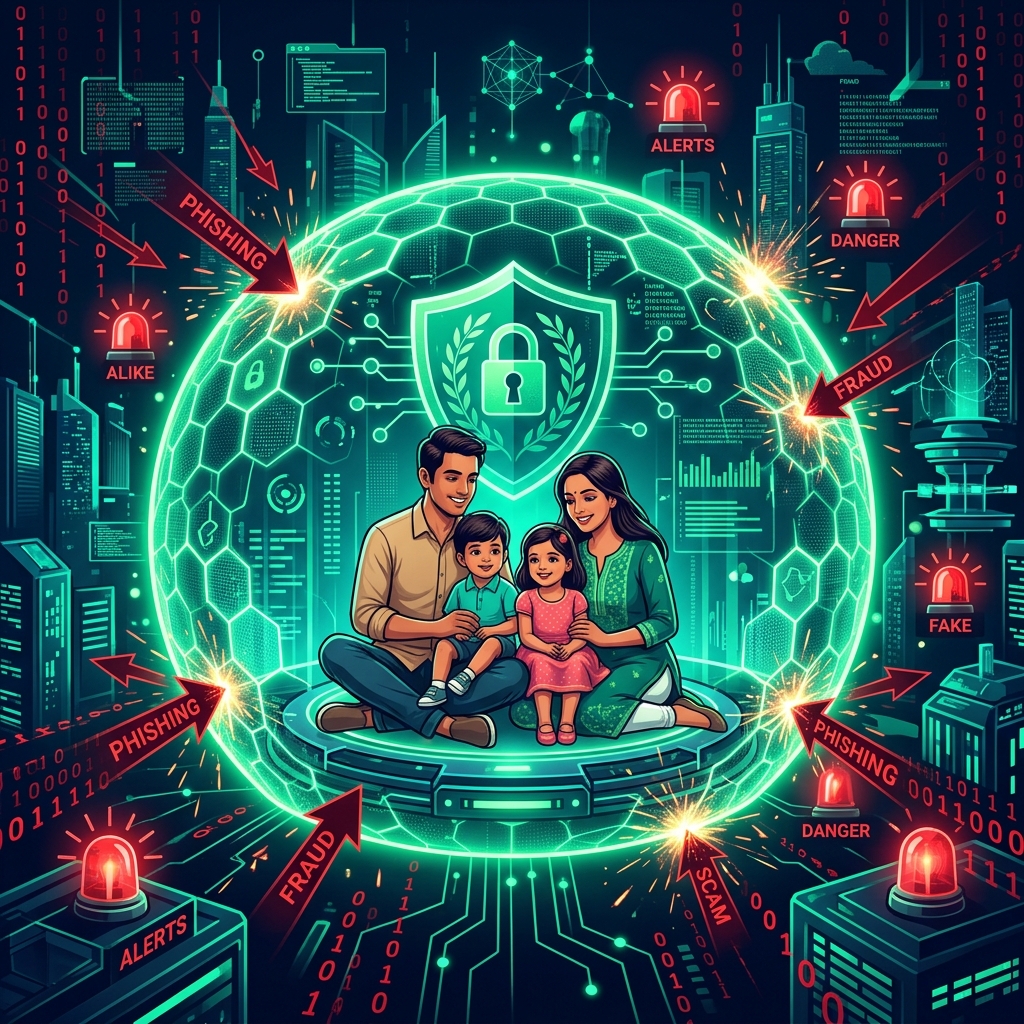
Rule #1: No Indian law allows arrest by video call.
Repeat this to yourself. Write it on your bathroom mirror. Tell your parents tonight.
Zero Tolerance: No law in India allows arrest via video call. Not the BNS/IPC, not the PMLA, not the CBI Act. No real police officer, ED official, or RBI representative will ever request you to stay on a video call. If they ask you to do so, it is 100% a scam. Hang up immediately.
Hang up. Immediately.
Rule #2: Hang up and call back directly.
If someone claims to be from your bank, your Aadhaar authority, the tax department — hang up on them. Then:
- Find the official number on your bank statement or the organization's official website
- Call THAT number (not one they give you)
- Ask: "Did someone just call me from your office?"
99% of the time, the answer is: "No. That was a scam."
For your bank: Check the back of your debit card for the official customer care number.
Rule #3: Real government officials will never threaten you on a call.
Real investigations happen slowly, with written notices, in person, at your home or office. They don't happen via video call at 11 PM.
If someone:
- Threatens you with immediate arrest
- Demands urgent money transfer
- Tells you not to tell anyone
- Asks you to install an app or open a video call
- Uses urgency language ("By tonight," "Right now," "You have 2 hours")
All of these are scam signals.
Rule #4: Real police don't use Skype, WhatsApp, or AnyDesk.
Law enforcement in India doesn't use consumer apps for investigations. Not WhatsApp. Not Skype. Not AnyDesk. Not Telegram.
If an "officer" asks you to download any app or open a video call on a consumer app: It's a scam.
Write this down: Government investigations happen in person, at government offices, with written documents.
Rule #5: Your Aadhaar number is not secret. Neither is your address.
Stop assuming that knowing your Aadhaar proves someone is official. Your Aadhaar is on public documents. It's in databases that get hacked. Knowing it means nothing.
Same with your address. Any criminal can find it in public records.
What distinguishes real officials:
- They have specific case numbers (which you can verify)
- They give you written notices (not verbal threats)
- They allow you to verify independently
- They never rush you
Rule #6: Tell someone immediately.
The scammers' greatest power is isolation. Break that isolation.
If anyone calls you claiming to be law enforcement with any kind of threat:
- Hang up
- Call your spouse or family
- Tell them exactly what happened
- Have them call 1930 (Cyber Crime Helpline) with you
- File a report at cybercrime.gov.in
Shame should never stop you from getting help. Over 92,000 digital arrest cases were registered in India in 2024 alone. You are not the first. You are not stupid. You were targeted by professionals.
Rule #7: Share this with elderly parents and grandparents TODAY.
The scam targeting Meera could have been stopped if her sister had been in the loop. The 92-year-old who got his money back was only saved because his family intervened within 48 hours.
Print this article. Leave it by your parents' phone. Send it to every family WhatsApp group.
The best defense against digital arrest is a family that knows the warning signs.
What To Do If You've Been Scammed: The 7-Minute Recovery Plan
If you've already transferred money or are currently on a fake call, here's the urgent sequence to minimize the damage:
Meera's Ending: The Lesson
On December 20, 2025, when Meera finally confessed to her sister, everything changed.
Her sister took her to the police station that same evening. They filed a report at cybercrime.gov.in. The case reference number was recorded. Delhi IFSO's Cyber Crime Unit was alerted to a similar pattern.
The scammers disappeared. The Telegram group dissolved. The fake "officer" blocked her.
Out of ₹2.05 crore transferred, Meera's family recovered ₹23 lakh through bank freezing orders. They lost ₹1.82 crore.
It was not a full recovery. But it would have been zero if she had never told anyone.
That's why the most important moment in a digital arrest scam isn't the moment of the call.
It's the moment you tell someone you trust that something feels wrong.
Meera did that. Late. But she did it. And it saved her from losing everything.
The Message That Matters
Tonight, call your parents. Call your grandparents. Send them this article. Tell them:
"There is no such thing as digital arrest in Indian law."
"Real police investigate in person, never via video call."
"If someone threatens you with arrest on the phone, it's a scam."
"If you ever get such a call, hang up and call me immediately."
"1930 is the cyber crime helpline — save it in your phone."
The Supreme Court is fighting this. The government is fighting this. Police are fighting this.
But the real protection comes from families protecting each other.
Because the scammers' greatest weapon is silence. And shame.
And your family's greatest weapon is knowing — truly knowing — that no law officer will ever arrest you via a video call.
Quick Reference: The Digital Arrest Red Flags
- Claims to be police/CBI/ED/RBI via phone
- Uses authority + your real personal data
- Shows "official documents" or "case files"
- Threatens immediate arrest
- Demands you stay on video call for hours
- Forbids you from telling family
- Asks for money transfer for "verification"
- Uses WhatsApp/Skype for "official investigation"
- Asks you to install apps like AnyDesk/QuickSupport
- Creates urgency ("By tonight," "In 2 hours")
Helpline Numbers (Save These)
- National Cyber Crime Helpline: 1930 (Free, 24/7)
- Emergency Police: 112 (Pan-India)
- Report Online: https://cybercrime.gov.in
- Block Fraud Numbers: https://sancharsaathi.gov.in
- Your Bank's Customer Care: Check your debit card (NOT Google search)
Written by: Krishna Muduli, CISSP | Cybersecurity Lead Engineer
For: KM CIPHER — Cybersecurity Awareness for India
Published: May 27, 2026
Have you received a digital arrest scam call? Share your story (anonymously if you prefer) to help others recognize the warning signs. Email: muduli.krishna12@gmail.com
This article is part of an ongoing series on cybersecurity threats targeting Indian families. Read more awareness content on https://www.krishnamuduli.co.in/cyber_blog.html