
A Normal Thursday That Changed Everything
Priya Kulkarni, 34, lives in Pune with her husband Suresh and their two children — Ria, who is eight, and Arjun, who just turned five. Suresh works at an automobile parts company. Priya had been managing the home for a few years, and since last year, she was quietly working on getting back into the job market.
She had updated her LinkedIn profile. Uploaded her resume on Naukri.com. Attended one online hiring webinar. She was hopeful. Things were looking up. She was a woman doing everything right — and that is exactly what made her a target.
That Thursday morning, the kids had left for school. Suresh was at the office. Priya was finishing the kitchen. Her phone rang. Unknown number. She almost didn't pick up.
But it was job search season. Could be a recruiter.
She answered.

He introduced himself as Vikram, from "Synergy HR Solutions." He spoke about a Pune-based company, a salary range that was real — not too good to be true. He asked about her experience. He even laughed at a small joke she made. The conversation felt natural. Human. Comfortable.
"He was talking so nicely — that's why I thought everything would be okay."
— Priya Kulkarni, recounting the call to a cyber crime officerThe niceness was the weapon. And nobody had warned her about that.
The Moment She Pressed "Merge"
They had been talking for about four minutes when Vikram said something that seemed completely normal.
She pulled the phone away, tapped "Merge Call," and a new voice came on. It was automated. Flat. Like a bank's phone system.
Priya paused. "Yeh kya tha?" She was about to ask — but Vikram jumped in instantly, smooth and fast.
Priya relaxed. She had barely even heard the numbers clearly. And she never said them aloud herself.
But here's the thing — she didn't have to say them.
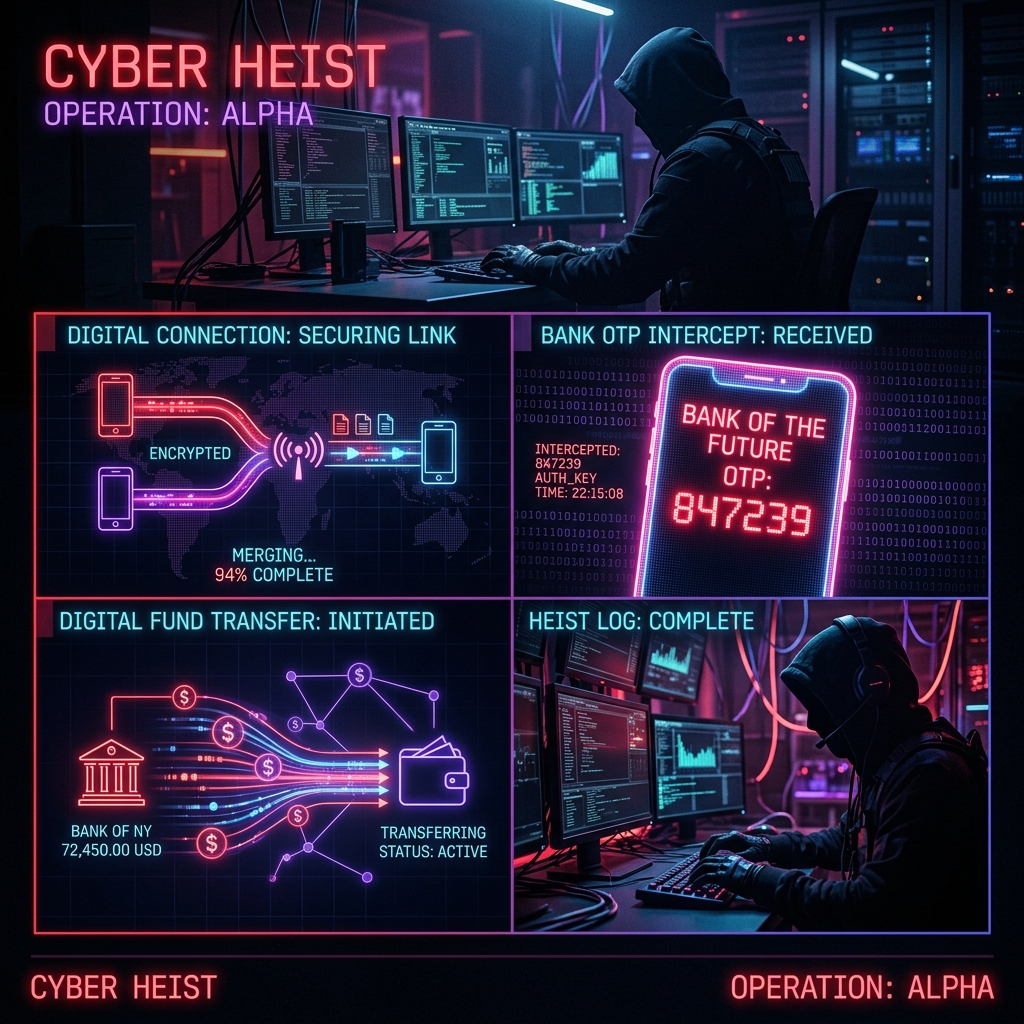
The scammer was already on the merged call. He heard every digit the bank's automated system read. He was already logged into Priya's banking portal — her account number obtained from the resume she had uploaded on Naukri months ago. He entered the OTP the moment he heard it.
The Anatomy of a Call Merge OTP Attack
Let's break this down in plain language — because once you understand the mechanics, it becomes impossible to fall for. And you'll be able to explain it to your parents tonight.
OTP stands for One-Time Password. Banks send it to your phone to verify a transaction. It's the final security gate. The idea is simple — only you have access to your phone, so only you can receive and use the OTP.
But banks also have IVR systems — automated phone services that read information aloud when you call them. And here's the gap the scammers figured out: some IVR systems deliver OTPs over the phone call itself. The moment you merge your call with theirs, you unknowingly become a three-way bridge — between the scammer, your bank's automated voice, and yourself.
The Evolution of This Scam in India
The SMS That Stopped Her Breathing
Vikram said "I'll send you the interview link on WhatsApp, ma'am" — and the call ended.
Ten seconds later, Priya's phone buzzed. Not WhatsApp. SMS. From her bank.
She read it three times. Her hands started shaking.
Yeh kya hua? Main ne kuch share nahi kiya tha toh.
("What happened? I didn't share anything.")
She called back the unknown number. It rang once. Then it was switched off. She called Suresh — he was in a meeting. She called her mother — she didn't understand. "Call the bank, beta. Call the bank immediately."
More Than Just Money
₹2,50,000. To many of us, that's a number. To Priya's family, it was Ria's school fees for two years. It was the down payment they had been saving for a two-wheeler. It was six months of grocery money.
When Suresh came home that evening, there was silence at the dinner table. He didn't shout. He didn't blame her. He just sat quietly for a long time. That silence — Priya said later — was worse than any argument.
"I felt so stupid," she told a friend. "I am not an uneducated person. I have done my graduation. I know about scams. But I didn't see this coming at all."
She stopped picking up calls from unknown numbers. She deleted her Naukri profile. She stopped talking about the job search. The ambition that had been building inside her for months — gone, along with the money.
Critical: In most call merge OTP scam cases, money is transferred instantly through multiple "mule" accounts. Recovery is extremely difficult. If this happens to you, call 1930 within the first 60 minutes — that is your best chance of freezing the transaction.
| City | Victim Profile | Scam Story Used | Amount Lost |
|---|---|---|---|
| Mumbai | Businessman, 42 | "Bank senior representative" wants to verify account | ₹2.5 lakh |
| Bengaluru | College student, 21 | "Scholarship committee" merge call verification | ₹60,000 |
| Gurgaon | Doctor (WhatsApp chain) | WhatsApp account compromised, 40+ colleagues scammed | Multiple lakhs |
| Noida | Working professional, 35 | Job offer from "MNC recruiter" | ₹1.14 lakh |
| Ludhiana | Housewife, 48 | Prize winner verification call | ₹85,000 |
Why Smart People Fall for This
Here's the uncomfortable truth. Priya isn't naive. The Gurgaon doctor wasn't careless. The Bengaluru student wasn't stupid. They are educated, alert, functioning adults — and they all fell for the same trick.
This scam doesn't exploit ignorance. It exploits something far deeper: trust, timing, and the way our brains work under social pressure.
What Traditional Scams Relied On
✓ Suspicious links
✓ Broken English
✓ Urgency and threats
✓ Obvious fake websites
✓ Asking you to "share your OTP"
Easy to spot. Easy to resist.
What Call Merge Scam Uses
✓ Normal conversation
✓ Perfect Hindi/English
✓ No links, no apps, no forms
✓ A simple, believable request
✓ You never say the OTP yourself
Invisible. Nearly undetectable in the moment.
The Psychology Behind the Trap
The call merge request exploits three things at once:

Expert Note (BioCatch, 2025): "While the call-merging scam has gained significant attention in India, the underlying principles align with global cybercrime patterns. It exploits the social instinct to trust — and to act fast. Once the OTP is compromised, the fraudster can practically take complete control of your bank account. You wouldn't even realize until the funds vanish."
What Priya Wishes Someone Had Told Her
After the scam, a cyber crime officer told Priya one sentence that stayed with her.
"Ma'am, the mistake wasn't that you picked up the phone. The mistake was merging the call without knowing exactly who was on the other end."
— Cyber Crime Officer, Pune PoliceSimple as that. And yet — nobody taught her. Not her bank. Not her school. Not a single WhatsApp forward had warned her about this exact thing.
That's why this article exists. So you know. And so you can tell the people you love before a stranger does — through the wrong kind of lesson.
8 Rules That Can Save Your Family's Savings
Share this section with your family WhatsApp group. These are the specific rules that would have saved Priya — and will protect your parents, siblings, and spouse if they see this before a scammer calls them.
- Never merge a call at a stranger's request. No legitimate recruiter, bank, HR team, or company needs you to merge a call as part of any real process. The request itself — from an unknown person — should be your immediate alarm signal. Hang up.
- If a second call comes while you are already speaking — let it ring. Ignore unknown incoming calls during an ongoing conversation. A real person will leave a message or call again. A scammer is counting on the urgency of that second ring.
- An unexpected OTP means something is already wrong. If you receive an OTP and you have not initiated any transaction yourself — stop everything. Call your bank directly. Do not proceed with whatever you were doing.
- No one should ever hear your OTP — not even by accident. If a bank's automated system reads your OTP aloud during a three-way call — that OTP is compromised. Never be in a situation where an unknown person is on a merged call while your bank speaks to you.
- Verify any caller independently before trusting their story. If someone claims to be from a company, search for that company's official number and call them yourself. Never use a number the caller gives you.
- Be careful about what you put on job portals. Your name, mobile number, and city on Naukri or LinkedIn can be used by scammers to call you with a convincing hook. Use a secondary number where possible, or limit what's publicly visible.
- Set low UPI transaction limits and enable instant SMS alerts. Go to your bank app right now. Set the daily UPI transfer limit to a lower amount. Enable SMS alerts for every transaction — even small ones. These 5 minutes of setup can save lakhs.
- If scammed, call 1930 immediately — within the first hour. Report at cybercrime.gov.in. Contact your bank's fraud helpline. The faster you act, the higher the chance of freezing the transfer before it moves through mule accounts.
Priya's Story Doesn't Have to Be Yours
Priya was not careless. She was not uneducated. She was not the type of person who "falls for scams." She was a mother, hoping for something good to happen — and someone used that hope against her. That is what these scammers do. They are professionals at finding the human moment and exploiting it.
The scam doesn't require your carelessness. It only requires your trust. And in India, we are a trusting people. That is a beautiful thing about us. But scammers know it, and they count on it.
So here is the one thing you need to remember. Write it down. Say it out loud. Tell it to everyone you know:
You don't have to live in fear. You don't have to stop picking up calls. You just have to know this one thing — so that when the moment comes, your hand pauses on "Merge Call," and a small voice says: wait.
That pause is worth ₹2,50,000.
Share this with your mother. Your father. Your wife who is job hunting. Your cousin who just moved to a new city. Your uncle who trusts everyone on the phone. One story, shared at the right time, can protect an entire family.
Priya's money is gone. But her story doesn't have to repeat.