← Back to Blog
OT Attack Explained Simply Food & Cold Chain

−18°C to +50°C Overnight: How Hackers Cooked Hundreds of Supermarket Freezers

On two nights in October and November 2026, freezers in hundreds of European supermarkets started warming up on their own. Some reached 50°C. Food was thrown away, a few stores caught fire, and a national blood service had to step in to protect its stock. Nobody broke into a shop. The attackers logged in to the boxes that control the fridges, over the internet. Here's what happened, in plain language, and what you should do about it.

Krishna Muduli, CISSP Cybersecurity Lead Engineer November 8, 2026 12 min read
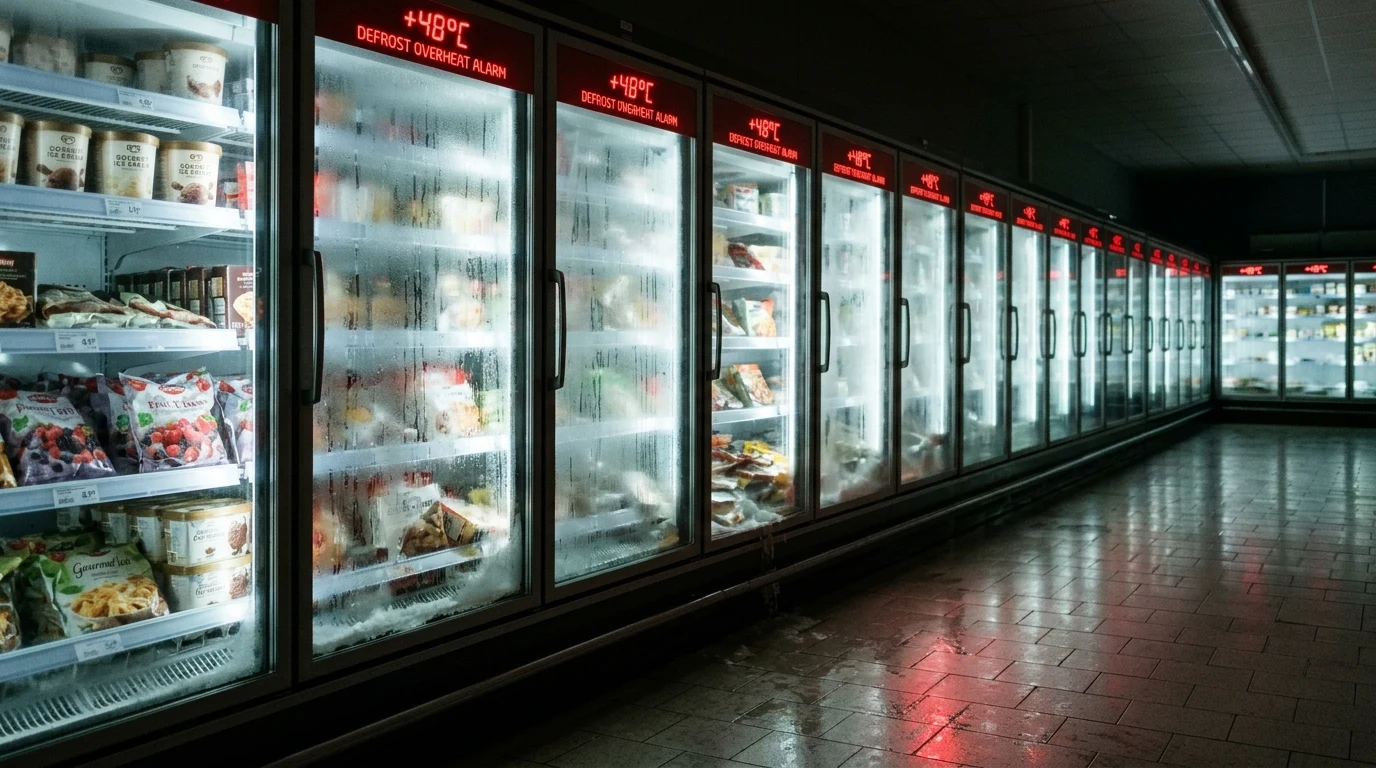
Photorealistic cinematic shot of a deserted European supermarket frozen food aisle at night with LED displays glowing +48°C defrost alarms and melting goods

We think of a cyberattack as something that happens to data: leaked passwords, locked files, an empty bank account. This one happened to ice cream, meat and medicine. The same remote-control box that lets a technician fix a fridge from home let a stranger turn it into an oven.

50°C
Highest temperature reported inside hacked units
100s
French supermarkets hit on the night of 11–12 October
115+
Stores in six more countries hit on 2 November
2,765
Controllers researchers found open on the internet
⚠️

This story is still moving. Police in France and Belgium are investigating, nobody has been confirmed as the attacker, and the exact way in hasn't been officially confirmed. I've written this with what was known on 8 November 2026 and I'll update it if anything important changes.

The short version

What was hit
Fridge controllersThe boxes that run supermarket cooling
What happened
Freezers warmed to 50°CFood spoiled, some French stores had fires
Where
7 European countriesFrance first, then six more a few weeks later
How they got in
Over the internetControllers left reachable, old software, weak passwords
Who did it
Not confirmedPro-Russian groups claimed it; unverified
Your fridge at home
Not this attackBut the lesson applies to every connected gadget

Wait, how is a freezer on the internet?

A big supermarket can have dozens of fridges and freezers, plus cold rooms at the back. They're all run by a small computer called a refrigeration controller, usually mounted in a plant room. It watches the temperature of every unit, switches compressors on and off, runs defrost cycles, and sends an alarm if something goes wrong.

Most stores don't employ a refrigeration engineer. They pay a contractor, and the contractor wants to check on hundreds of stores without driving to each one. So the controller gets a web page that the engineer can open from anywhere. That's the convenient part. The dangerous part is when that web page is open to everyone on the internet, not just the engineer.
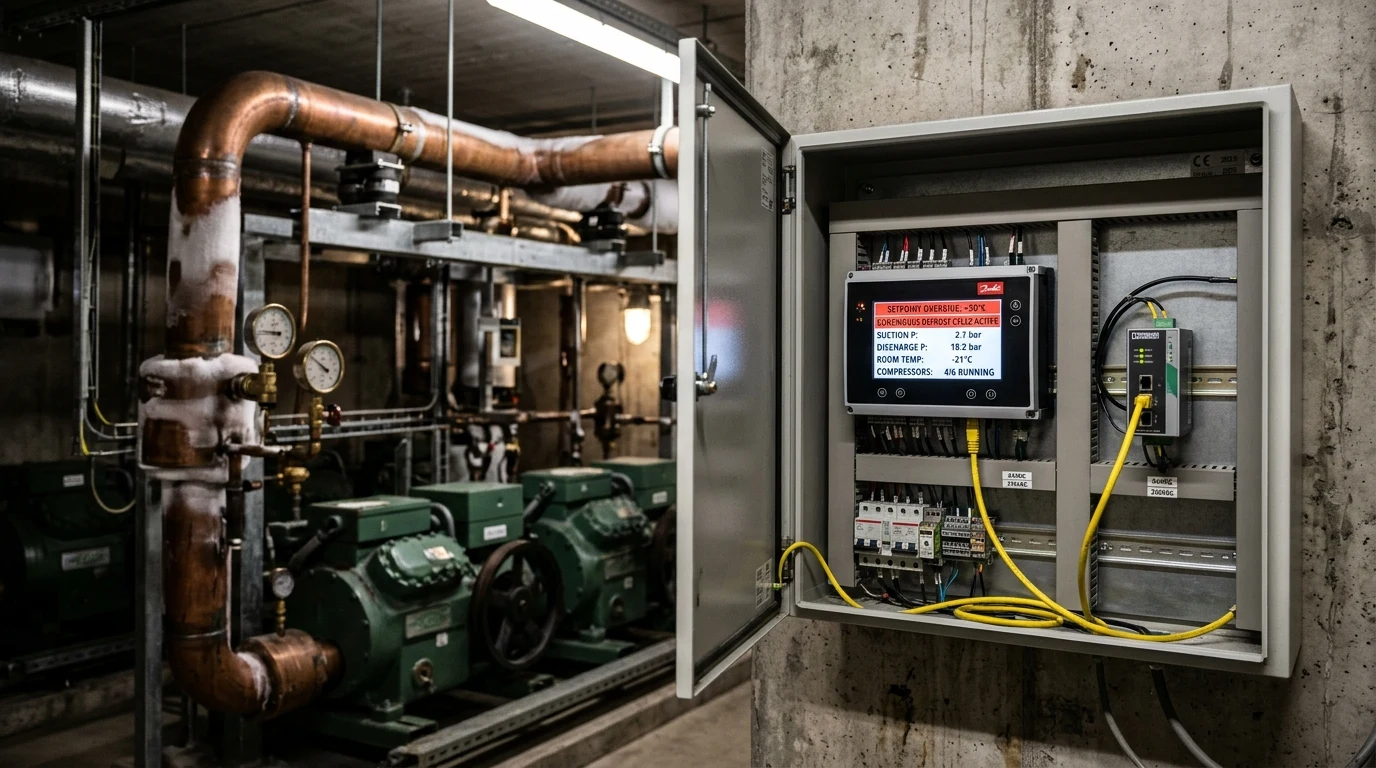
Back-of-store industrial refrigeration compressor plant room with exposed Danfoss automation controller touchscreen showing network overrides
Figure 1: Industrial back-of-store plant room showing a wall-mounted refrigeration automation controller panel and network switch. Remote management interfaces left exposed directly to the public internet allow unauthorized external attackers to override cooling parameters and defrost cycles store-wide.
SYSTEM TOPOLOGY // ATTACK SURFACE

One Web Page, Two Very Different Visitors

Refrigeration controllers cannot distinguish a maintenance contractor from a cyberattacker when exposed directly to the public internet.

INSECURE // PUBLIC EXPOSURE
Direct Public Ingress (Port 80/443)
Contractors exposed the controller's HTTP/HTTPS management portal directly on WAN IP addresses for convenience, allowing global scan engines to discover it.
2,765+ Units Indexed on Shodan
🌐 Public Internet UNFILTERED
▼ Shodan Port Scan
⚡ Danfoss AK-SM 800A Web UI PORT 80/443
▼ Auth Bypass (CVE-2025-41450)
🔥 Defrost Heaters & Compressors +50°C OVERRIDE
INGRESS: WAN DIRECT SECURITY: NONE (EXPOSED)
HARDENED // DEFENSE-IN-DEPTH
Segmented OT Enclave + VPN Bastion
Zero WAN exposure. External technicians authenticate through an encrypted VPN gateway with hardware MFA before reaching an isolated industrial VLAN.
0 Exposed Ports to Public Internet
🔒 Contractor Laptop FIDO2 / MFA
▼ Encrypted WireGuard / IPsec Tunnel
🛡️ Firewall / OT Bastion Gateway ISOLATED VLAN
▼ Supervised Read/Write Session
❄️ Controller + Thermal Cutoff Relay −18°C SAFE INTERLOCK
INGRESS: PRIVATE VPN ENCLAVE SECURITY: SEGMENTED (ZERO TRUST)
💡
Key Architecture Flaw: Supermarket refrigeration controllers are full Linux computers that operate physical high-voltage relays. Placing them behind a standard VPN completely removes them from global attack scanners, blocking opportunistic intrusions before they begin.

Some shop owners didn't even know their fridges were online. Marta Rybczynska, a specialist in securing connected equipment, told Ireland's RTÉ that in some cases the contractor ran the system and the store never knew. She also said some older models use passwords that are easy to guess, "like the current date".

Night one: France, 11–12 October

Overnight from Sunday to Monday, fridges and freezers in French supermarkets started heating up. By morning, Intermarché said between 150 and 200 of its stores had been targeted, and Coopérative U said almost 100. Carrefour and Monoprix said some of their branches were hit too, and BFM TV reported that E.Leclerc was affected. Later estimates put the total at several hundred stores.

Temperatures went as high as 50°C. Frozen and fresh food had to be thrown away, and in several stores equipment overheated and caught fire. The Paris prosecutor's office opened an investigation into what it called a "large-scale" attack "affecting connected refrigerators in several major food retailers across France".

"Targeting equipment essential to the preservation of fresh products and to the food supply of the French people is of extreme gravity and is unprecedented."

Dominique Schelcher, CEO of Coopérative U, October 2026

One detail stood out. The frozen-food chain Picard, which looks after its refrigeration systems in-house rather than through contractors, was reportedly not affected.

Night two: 2 November, across Europe

Three weeks later it happened again, on a bigger map. In the early hours of Monday 2 November, more than 115 stores in Belgium, the Netherlands, Luxembourg, Sweden, Ireland and Estonia reported the same thing: cooling systems shut down or temperatures changed remotely.

🇧🇪
Belgium & LuxembourgDozens of Delhaize stores, about 15 Carrefour stores, 15 Intermarché stores, 5 Spar stores (Colruyt), and IKEA's store in Mons.
🇸🇪
SwedenICA and Coop stores. Coop said six or seven of its roughly 800 stores had units stop working or work only partly.
🇮🇪
IrelandMusgrave said 13 SuperValu stores were affected. Chilled and frozen food was taken off sale; it was resolved that evening.

A Belgian butcher chain, De Laet & Van Haver, said the fridges at its store near Antwerp were pushed to 18°C, ruining about €15,000 of meat. Belgium's prosecutor opened a criminal investigation.

The same day, France's national blood service (EFS) said an attack on one of its refrigeration suppliers had raised temperature and defrost settings at three of its sites. It was stopped before the blood stocks were harmed. That's when this stopped being only about groceries.

How do you turn a freezer into a heater?

This is the part I found most interesting, because the attackers didn't need to switch the freezers off. They used a feature that's already there.

Freezers build up ice on their cooling coils, so every few hours the controller runs a defrost cycle: it switches on small heaters next to the coils for a short time to melt the ice, then goes back to cooling. That's normal. Now imagine someone tells the controller to defrost all the time, and raises the target temperature from −18°C to +50°C. The heaters keep running, the cold air stops, and a sealed glass cabinet slowly becomes a warm box.

That matches what the people cleaning up described. Stephan Moelans, CEO of Sabcobel, the Belgian refrigeration company that runs the systems for Delhaize and other chains, told Belga that the units' evaporators had been "switched into defrost mode". The US government later warned that attackers may try to "force units into continuous heating and defrost cycles".
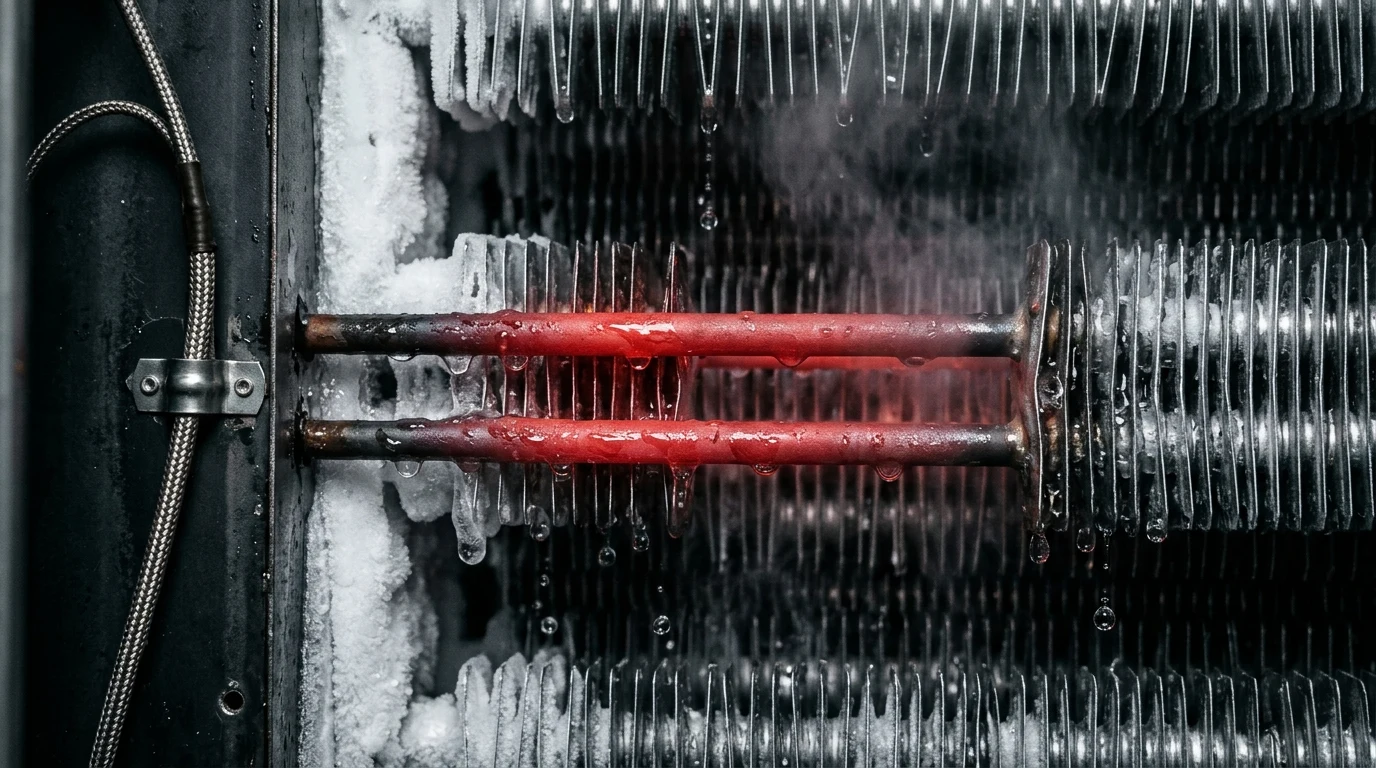
Commercial supermarket evaporator coil assembly with resistance defrost heating elements glowing cherry-red amidst melting frost
Figure 2: Commercial evaporator coil assembly with electric resistance defrost heaters energized. When cyberattackers override controller setpoints to +50°C and force continuous defrost mode, refrigerated display cases turn into ovens, leading to catastrophic perishable inventory loss and compressor fires.
KILL CHAIN // SABOTAGE PATHWAY

From a Search Engine to a Spoiled Freezer

Reconstruction of the multi-stage OT exploitation sequence that transformed supermarket freezers into defrost ovens across Europe.

01
PRE-ATTACK RECONNAISSANCE SHODAN ENUMERATION
Automated Discovery of Internet-Exposed Controllers
Attackers leverage IoT search engines like Shodan and Censys using queries for Danfoss HTTP titles, SSL certificates, and default ports. Claroty researchers found 2,765 AK-SM 800/800A controllers indexed publicly.
02
THE NIGHT OF THE INTRUSION AUTH BYPASS
Authentication Bypass & Credential Abuse
Attackers bypass the web portal login. They exploit CVE-2025-41450 (the date-derived algorithmic master password), default factory logins, or contractor-shared credentials on unpatched or end-of-life systems.
03
02:00 AM OFF-HOURS EXECUTION SETPOINT INVERSION
Remote Defrost Override & Temperature Escalation
Operating in the dead of night when stores are locked and unstaffed, intruders force manual defrost cycles and jack target temperature setpoints from −22°C up to +50°C, energizing electric resistance heating elements.
04
04:00 AM THERMAL RUNAWAY PHYSICAL DAMAGE
Continuous Defrost Heating & Electrical Fires
Without hardwired thermal cutoff switches, defrost coils continue heating unabated. Temperatures surpass 50°C. Compressor units suffer severe thermal strain, and in multiple French supermarkets, overheating wiring ignites fires.
05
07:00 AM STORE OPENING INVENTORY SPOILAGE
Total Perishable Loss & Emergency Disposal
Morning staff discover melted ice cream, warm meats, and flooded aisles. Supermarket chains across France, Belgium, and Ireland are forced to scrap hundreds of tons of food inventory, incurring millions in direct losses.
⚠️
Tactical Dwell Time: Saboteurs purposely executed their scripts between midnight and 3:00 AM. This bought them a 5-to-6 hour operational window before on-site workers could physically inspect the cabinets and pull circuit breakers.

The flaws were found months earlier

Danfoss, a Danish company, makes some of the most widely used supermarket refrigeration controllers. Its systems were among those targeted in both waves, along with Copeland/Dixell XWEB controllers. Researchers at Claroty Team82 had already looked closely at one Danfoss model, the AK-SM 800A, and reported three flaws. Danfoss fixed them in a firmware update. The US cybersecurity agency CISA published an advisory about two of them in May 2025.

VULNERABILITY RESEARCH // CVE ANALYSIS

Three Flaws, Explained Without the Jargon

The trio of critical vulnerabilities discovered in Danfoss AK-SM 8xxA refrigeration controllers (Claroty Research / CISA Advisory ICSA-25-141-01).

CVE-2025-41450 // CVSS 9.8
Date-Derived Master Key
A hidden maintenance backdoor used an algorithmic formula based on the current date to generate the daily root password. Anyone who decompiled the firmware knew the formula and could compute the password for any day.
9.8 Critical Base Score
VECTOR: AUTH BYPASS SKIPS LOGIN ENTIRELY
CVE-2025-41451 // CVSS 8.8
E-mail Parameter Command Injection
The alarm notification settings page passed unsanitized text from the SMTP e-mail password field directly to the controller's underlying Linux shell. Entering shell characters executes arbitrary operating system commands.
8.8 High Severity Score
VECTOR: OS INJECTION RUNS ARBITRARY CODE
CVE-2025-41452 // CVSS 7.2
Web Server Parameter Hijacking
An authenticated user could tamper with HTTP parameters to overwrite configuration directives in the internal web server. This allowed attackers to manipulate system paths and establish persistent reboot-resistant backdoors.
7.2 High Severity Score
VECTOR: CONFIG TAMPERING PERSISTENCE ESCALATION
📌
Firmware Remediation & Legacy Hardware: Danfoss released firmware patch R4.3.1 for the AK-SM 800A to eliminate these flaws. However, legacy AK-SM 800 series controllers reached official End-of-Life in 2021 and receive no security patches—leaving them permanently vulnerable unless physically isolated from the internet.

That last point matters. You can't patch a controller the maker stopped supporting years ago. Sabcobel's CEO said many units would need physical changes to be protected, and "that requires investment". Fridges last a long time. A controller installed in 2012 can still be running the cold aisle today, quietly connected to the internet the whole time.

This had happened before, on a smaller scale

According to Danfoss, 16 supermarkets in Russia and 40 stores in Israel using its AK-SM 800 controllers were hacked in 2022. Danfoss said all 40 Israeli stores "lacked proper firewall or VPN protection". The warning was there four years ago.

What happened next

INCIDENT TIMELINE // CAMPAIGN ESCALATION

From Early Warning to Coordinated Waves

Chronology of the cold-chain cyber crisis, from early Israeli store intrusions in 2022 to the pan-European sabotage operations of late 2026.

2022 // EARLY WARNING
Precursor Attacks in Israel & Russia
Danfoss controllers in 16 Russian and 40 Israeli retail stores are hijacked. Investigation confirms the Israeli sites had no firewalls, VPNs, or network isolation in front of their web interfaces.
TARGET: 56 RETAIL STORES UNPROTECTED WAN
MAY 2025 // DISCLOSURE
CISA Advisory ICSA-25-141-01
Claroty research team publicly discloses three zero-day vulnerabilities in Danfoss AK-SM 800A controllers. CISA issues a federal advisory and Danfoss releases firmware patch R4.3.1.
DISCLOSURE: CLAROTY PATCH R4.3.1 RELEASED
11–12 OCT 2026 // WAVE 1
France Supermarket Meltdown
Over 100 French supermarkets (Intermarché, Delhaize, SuperValu) lose cooling simultaneously overnight. Temperatures surge to +50°C, causing food loss and fires. Paris prosecutor opens cyber terrorism inquiry.
SURGE: +50°C RECORDED FIRES & FOOD SPOILAGE
29 OCT 2026 // MILITARY PROBE
US Defense Cold-Storage Inquiries
Reuters reports the Pentagon and Defense Logistics Agency investigating widespread refrigeration malfunctions across domestic military bases as suspected coordinated cyber sabotage.
INVESTIGATION: PENTAGON MILITARY BASES HIT
02 NOV 2026 // WAVE 2
Pan-European Spread & Blood Banks
Over 115 stores hit across France, Belgium, Germany, and Ireland. The sabotage breaches third-party vendor systems managing temperature controls for the French National Blood Service (EFS).
SCOPE: 6 COUNTRIES EFS BLOOD SITES TARGETED
05 NOV 2026 // GLOBAL FLASH
Joint CISA & FBI Global Advisory
CISA, FBI, and federal partners issue an emergency flash alert warning of an active, ongoing cyber campaign targeting commercial refrigeration and cold-chain operational technology worldwide.
ALERT: CISA / FBI FLASH WORLDWIDE THREAT ACTIVE

"Every organization that depends on refrigeration and monitoring systems should assume it could be a target."

Chris Butera, CISA's acting cybersecurity chief, November 2026

Who did it?

Honestly, nobody knows yet. Two pro-Russian hacking groups, NoName057(16) and Z-Pentest Alliance, claimed on Telegram to have hacked Danfoss technology, but their involvement hasn't been independently confirmed. Some researchers have pointed at Iran instead. The US government statement didn't name anyone, and it isn't known whether the October and November waves were the same people.

What does seem clear is the motive. There was no ransom note and no money to collect. Rybczynska suggested the goal may simply have been to cause "unrest". Empty freezer aisles in seven countries, the same month, do that very well.

Am I affected?

THREAT IMPACT // EXPOSURE MATRIX

Who Needs to Worry, and About What

Evaluating operational risk across retail consumers, smart home owners, commercial grocers, and critical healthcare cold storage.

CONSUMERS // LOW RISK
Retail Shoppers
Supermarket chains discarded warmed inventories before restocking. Check frozen items for signs of refreezing (dense ice clumps, distorted boxes, frosted surfaces) before eating.
LOW Direct Threat Level
SCOPE: FOOD SAFETY AUDIT STORE GOODS
SMART HOMES // MINIMAL
Home Kitchen Fridges
Smart home fridges (Samsung, LG) were not part of this campaign. However, isolate IoT appliances on a dedicated Wi-Fi guest network and disable UPnP on your home router.
N/A Not Industrial OT
SCOPE: CONSUMER IOT ISOLATE GUEST WI-FI
PRIMARY TARGET // HIGH
Grocers & Cold Stores
Businesses relying on outsourced refrigeration maintenance are directly vulnerable. Lack of visibility into vendor connections leaves controllers wide open to public internet attacks.
HIGH Direct Attack Target
SCOPE: COMMERCIAL OT ENFORCE CONTRACTOR VPN
CRITICAL LIFE SAFETY
Hospitals & Blood Banks
Vaccines, plasma, and temperature-sensitive biologics spoil permanently within hours of a temperature spike. The intrusion into the French blood agency shows attackers target life-critical supply chains.
CRIT High-Consequence Risk
SCOPE: HEALTHCARE OT MANDATE GxP INTERLOCK

Why this matters in India too

None of the reported attacks were in India, but the ingredients are here. Quick-commerce dark stores, cloud kitchens, supermarket chains, cold-storage warehouses and the vaccine and medicine cold chain all depend on refrigeration that's increasingly monitored remotely, often by third-party contractors. An attacker scanning for exposed controllers doesn't care which country a device is in. If you run or secure any of these, assume you're on the same internet as the French supermarkets.

When hacks reach the physical world

Attacks on operational technology (OT), the computers that control physical machines, are not new. What's different here is how ordinary the target was. Put a few side by side:
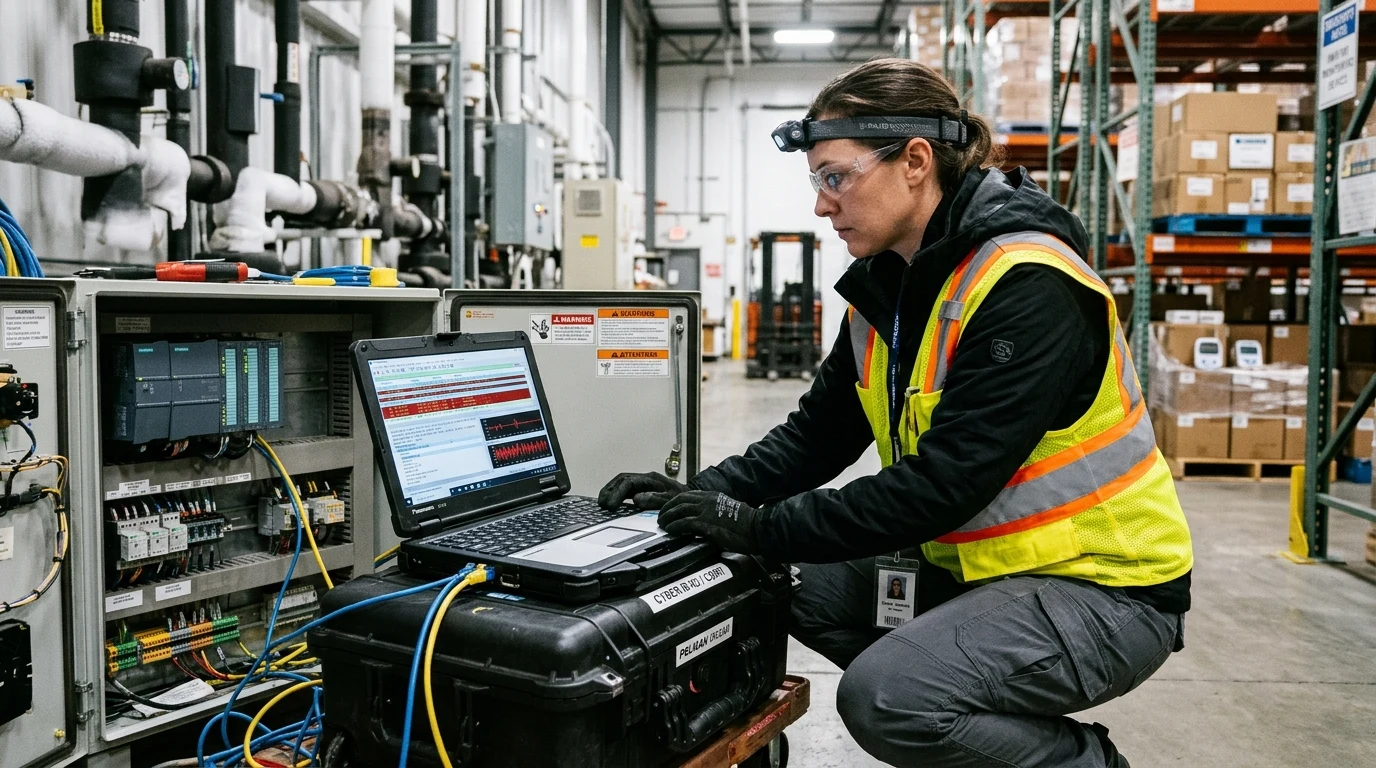
OT cybersecurity specialist in high-visibility vest performing forensic packet analysis on rugged field laptop connected to industrial control cabinet
Figure 3: Industrial OT cybersecurity and SCADA incident responder inspecting live packet captures and Modbus/BACnet telemetry on a ruggedized field laptop connected directly to an open electrical control enclosure during emergency triage in a cold-chain logistics facility.
CYBER-PHYSICAL THREATS // HISTORICAL MATRIX

Same Weakness, Newest First

A comparative analysis of cyber-physical attacks demonstrating how internet-exposed operational controllers consistently lead to physical infrastructure damage.

2026 // REFRIGERATION
EU Supermarket Freezers
Target: Danfoss AK-SM 800/800A controllers across hundreds of European supermarkets and cold storage hubs.
Vector: Port 80/443 exposed on internet; CVE-2025-41450 date-derived master key & default credentials.
Physical Damage: Defrost heaters forced continuously; cooling units heated to +50°C, causing spoiled food & equipment fires.
ATTRIBUTION: HACKTIVIST WAN PORT EXPOSURE
2024 // MUNICIPAL WATER
Danish Waterworks
Target: Municipal water purification and distribution telemetry systems in Denmark.
Vector: Internet-accessible SCADA web portals without network boundary enforcement or multifactor authentication.
Physical Damage: Pumping algorithms and water distribution valves manipulated; classified as destructive sabotage by Danish intelligence.
ATTRIBUTION: Z-PENTEST (GRU) UNAUTHENTICATED SCADA
2023 // CRITICAL UTILITY
Aliquippa US Water Authority
Target: Unitronics Vision-series programmable logic controllers (PLCs) regulating water pressure booster stations.
Vector: Internet-accessible PLC interface left on factory default management password ("1111").
Physical Damage: Automated booster regulation disabled; plant operators forced to switch to manual physical valves.
ATTRIBUTION: CYBERAV3NGERS (IRGC) DEFAULT "1111" PASSWORD
2022 // RETAIL PRECURSOR
Israeli Supermarket Chain
Target: Danfoss refrigeration units deployed across approximately 40 grocery branches in Israel.
Vector: Controllers directly exposed to WAN without a border firewall or VPN gateway, per manufacturer post-mortem.
Physical Damage: Temperature setpoint tampering disrupted cooling, serving as an unheeded architectural warning.
ATTRIBUTION: REGIONAL ACTORS ABSENT FIREWALL / VPN
⚡
The Common Pattern: None of these attacks required proprietary zero-day military exploit chains. In every case, attackers simply found a physical machine with an internet-accessible web server protected by weak, default, or absent credentials.

What you should do

At home

🔄
Update your smart appliancesFridges, ACs, cameras and TVs get security updates too. Turn on automatic updates in the maker's app, and replace devices the maker no longer supports.
📶
Put gadgets on a guest Wi-FiMost home routers have a guest network. Put smart devices there so a hacked fridge can't reach your laptop or phone.
🔑
Change default passwordsOn the router and on every app account for your devices. Turn off remote-access features you don't use, and turn off UPnP on the router if you don't need it.

If you run a shop, restaurant or cold store

You don't need to be technical. You need to ask your refrigeration contractor three questions, and get the answers in writing.

🌐
"Can our controller be reached from the internet?"The right answer is "no, only through a VPN" or a similar secure remote-access service. "It has a password" is not enough.
🗓️
"Is it still supported, and is it updated?"Ask for the model and firmware version. If it's end of life, ask for a replacement plan and a price.
🚨
"Who gets the alarm at 2 a.m.?"Both attacks happened overnight. Make sure a temperature alarm reaches a real person by phone or SMS, not just an e-mail inbox.

And one low-tech safeguard: a cheap stand-alone thermometer with its own alarm, not connected to the controller, in your most valuable freezer. If the controller lies or goes quiet, the thermometer won't.

If you run security for a business with refrigeration or other OT

The CISA, FBI, HHS, USDA and DOT fact sheet is short and worth reading in full. Here's how I'd put it in order:

DEFENDER BLUEPRINT // REMEDIATION ROADMAP

What Security Teams Should Do, in Order

A prioritized operational blueprint for defending building management, refrigeration, and cold-chain operational technology from remote sabotage.

PRIORITY 0 // IMMEDIATE (24 HOURS)
Close Internet Ingress & Enforce VPN/MFA
Scan all company external IP ranges with Shodan/Censys to identify reachable controllers (ports 80, 443, 8080). Immediately drop WAN port forwarding rules. Force contractor remote access through an enterprise VPN or zero-trust bastion requiring hardware MFA.
WINDOW: 0 - 24 HOURS SEVERITY: CRITICAL P0
PRIORITY 1 // SHORT TERM (7 DAYS)
Rotate Passwords & Patch Controller Firmware
Revoke every factory default and contractor-shared administrator credential. Apply Danfoss firmware update R4.3.1 (or latest vendor patch) to address CVE-2025-41450/1/2. For legacy End-of-Life controllers (AK-SM 800), initiate immediate hardware replacement budgets.
WINDOW: 1 - 7 DAYS SEVERITY: HIGH P1
PRIORITY 2 // MEDIUM TERM (30 DAYS)
Purdue Model OT Network Segmentation
Isolate refrigeration controllers and sensor buses on a dedicated OT VLAN with strict stateful firewall inspection. Prevent corporate office workstations, point-of-sale registers, and guest Wi-Fi networks from establishing direct connections to industrial controllers.
WINDOW: 30 DAYS SEVERITY: MEDIUM P2
PRIORITY 3 // STRATEGIC (90 DAYS)
Vendor Governance, Telemetry & Hardware Cutoffs
Update contractor maintenance SLAs to mandate cybersecurity standards and audit rights. Install independent, hardwired bimetallic thermal cutoff switches on defrost circuits to mechanically cut power if temperature exceeds safe thresholds (+5°C), regardless of software state.
WINDOW: 90 DAYS SEVERITY: STRATEGIC P3
🛡️
The Golden Rule of OT Security: Never rely exclusively on software controls to protect physical life and physical goods. Inexpensive electromechanical high-temperature cutouts physically cut current to defrost heaters if temperatures climb, guaranteeing physical safety even under total software compromise.
Commands: check whether your controller is visible from the internet

Run this from outside your network (a mobile hotspot or a cloud server), against your own site's public IP address only. If any of these ports answer, find out what's behind them. Only scan addresses you own or have written permission to test.

bash
# your site's public IP (run this from inside the store network first)
curl -s https://ifconfig.me ; echo

# then, from OUTSIDE the network: which common web and remote-access ports answer?
nmap -Pn -sV -p 21,22,23,80,443,502,8080,8443 YOUR.PUBLIC.IP

# if 80/443/8080/8443 is open, see what the login page says it is
curl -skI https://YOUR.PUBLIC.IP/ | head -20
curl -sk  https://YOUR.PUBLIC.IP/ | grep -io '<title>[^<]*' | head -1

You can also look up your public IP on Shodan or Censys (for example https://www.shodan.io/host/YOUR.PUBLIC.IP). If a search engine has already listed your controller, assume attackers have seen it too.

Commands: find connected controllers on the store network, gently

Old controllers can be fragile, and an aggressive scan can upset them. Get the contractor's agreement first, scan outside trading hours, and keep it light: find live devices, then look at only the web ports.

bash
# 1. which devices are alive on the store subnet? (no port scan)
nmap -sn 192.168.10.0/24 -oG - | awk '/Up$/{print $2}'

# 2. for each device you don't recognise, ask only about web ports, slowly
nmap -sV -T2 -p 80,443,8080,8443 192.168.10.50

# 3. can it reach the internet on its own? (from the device's VLAN, test outbound)
#    a controller should only talk to the hosts it needs, not the whole internet

Your quick checklist

Ask your refrigeration contractor how remote access works

VPN or secure gateway, never an open login page.

Check your public IP from outside

No controller or building system should answer.

Know the model and firmware of every controller

Update it, or plan and budget to replace it.

Make sure a night-time alarm reaches a person

Plus a stand-alone thermometer in the most valuable freezer.

At home: update smart gadgets and use guest Wi-Fi

And change any default passwords.

What I take away from this

None of this needed a clever hacker. The flaws were published. The fixes existed. The 2022 attacks in Israel had already shown what happens when the controllers are left without a firewall. What was missing was someone who owned the problem: the store thought the contractor had it, the contractor was managing hundreds of sites, and the controller just sat in the plant room, doing its job and listening to the internet.

It's the same pattern I wrote about in the Binance post, from the other end. There, attackers went after people because the systems were well protected. Here, they didn't need to fool anyone, because the systems weren't protected at all. Most security budgets go to laptops and servers. The fridge, the air conditioning and the lifts are computers too, and attackers have noticed.

So the question for every business is a simple one: what in your building can be controlled from outside, and who's checked? If nobody knows, that's the answer to start with.

Sources


Share With Anyone Who Runs a Shop, Kitchen or Cold Store

LinkedIn WhatsApp